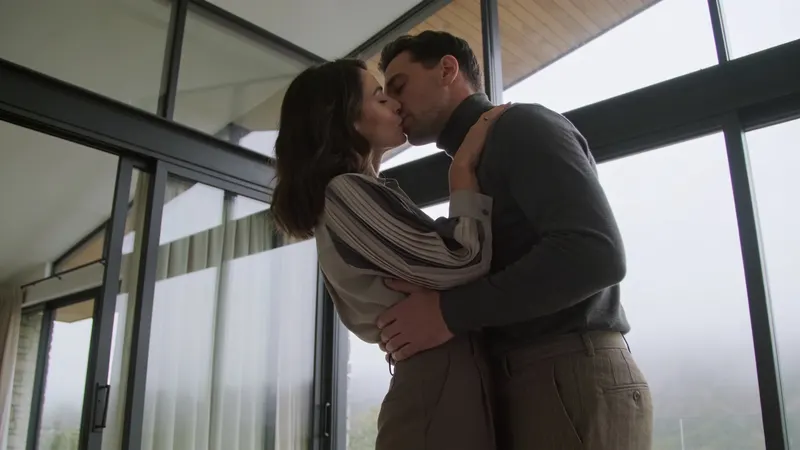
Curtains Open on Purpose
Synopsis
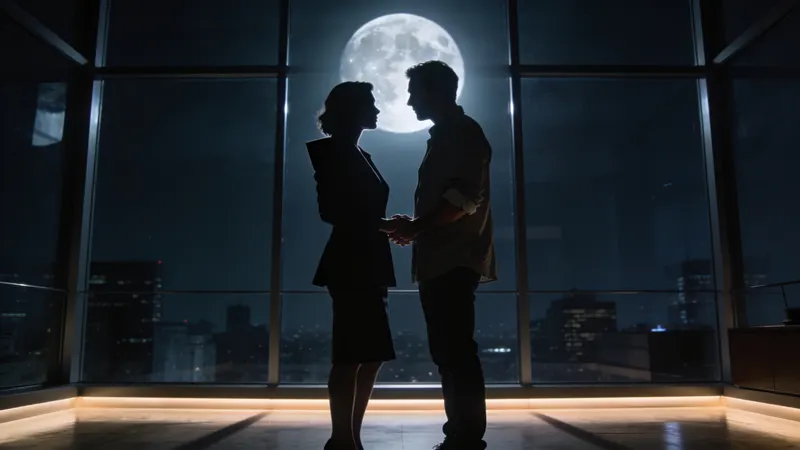
At forty-one, photographer Serafinne ‘Sera’ Moreau returns to Big Sur to confront the past—and Adrian Vale, the 49-year-old architect who left without explanation a decade ago. In a glass villa where mirrors blur privacy and curtains stay open on purpose, their second chance unfolds through charged silence, shifting light, and consensual voyeurism. As boundaries dissolve, being seen becomes the most intimate act. Heat level 4. Content: emotional vulnerability, adult themes, erotic mirror scenes.
What to expect
- A slow-burn reunion charged with unspoken history
- Erotic tension built through light, glass, and reflection
- Consensual exhibitionism as emotional revelation
- A hidden archive of longing that redefines their past
- A climax where being seen becomes an act of love
Tropes: Second chance, Forbidden romance, Workplace romance
Content notes: consensual voyeurism, emotional vulnerability, adult themes
Story details
| Chapters | 3 |
|---|---|
| Reading time | 14 min |
| Spice level | 4/5 |
| Rating | – |
| Reads | 0 |
| Status | Complete |
| Published | |
| Updated |
Chapter 1: The Glass Threshold
Serafinne ‘Sera’ Moreau, 41 years old, adjusted her lens, fingers steady, though her breath caught at the sight of Adrian Vale, 49 years old, standing in the glass doorway, unchanged and utterly unfamiliar. The fog curled around the villa like a held secret, softening the edges of the steel frame and swallowing the horizon whole. She hadn’t seen him in ten years, not since that final, wordless morning in Paris when she’d woken to an empty bed and a note that said only, I can’t do this. No explanation. No goodbye. Just silence where there had once been heat, laughter, the quiet rhythm of two bodies learning each other in the dark.
And now here he was, taller than she remembered, or maybe it was the way he held himself, spine straight, shoulders squared, as if his own architecture had shaped him. His dark hair was threaded with silver at the temples, his jaw clean-shaven, his eyes behind minimalist frames as unreadable as blueprints. He wore a charcoal turtleneck and linen trousers, the kind of clothes that looked effortless but cost more than her camera lens. He didn’t smile. He didn’t move. Just watched her through the glass, a man built for precision, for control, for spaces that revealed only what they intended to.
She lifted her chin. “Adrian.”
“Serafinne.” Her full name, like a formality, like a boundary.
She stepped forward, boots clicking against the slate threshold. “You haven’t changed.”
“And you have,” he said, finally stepping aside to let her in. “Or maybe I just forgot how much light you carry with you.”
She paused, the compliment sharp with hesitation. Was it a compliment? Or an accusation? Light was dangerous here. The entire house was a cage of glass, every wall a mirror, every surface reflecting something back, too much, too often. She’d always loved that about his designs: the way they invited the outside in. Now, standing in the foyer, she felt exposed, as if her skin had been peeled back and laid bare under the gray sky.
She set her bag down, unzipped it with deliberate calm. “I’ll start in the living area. The magazine wants natural light, candid angles.”
He nodded. “Take what you need.”
She moved through the space like a trespasser, though every step was familiar. The arc of the ceiling, the way the floor sloped slightly toward the ocean view, the single chandelier suspended like a frozen explosion above the seating area, she remembered all of it. He’d sketched it on a napkin in a Lyon café, drunk on wine and possibility, whispering, One day, I’ll build a house that holds the sky. She’d kissed him, tasted salt and ambition.
Now, as she framed her first shot, she caught him in the mirror behind the sofa, standing in the hallway, arms crossed, watching her. Not approaching. Just… observing. Like she was part of the architecture.
She turned. “You don’t have to hover.”
“I’m not hovering. I’m hosting.”
“You’re staring.”
He didn’t deny it. “You’re easier to look at than the fog.”
A beat. Then she laughed, low and surprised. “Still terrible with compliments.”
“And you’re still impossible to ignore.”
The air between them thickened, charged with the weight of a decade folded into a single sentence. She turned back to her camera, adjusting the aperture, buying time. But when she glanced up, he was still there, in the glass, in the reflection, in the corner of her eye.
She moved to the chandelier, angling her shot upward. Sunlight, weak and fractured, pierced through the coastal mist, scattering prismatic shards across the floor, across her hands, across her throat. She lifted her face into the light, eyes closed, just for a moment, just long enough to remember what it felt like to be seen without fear.
When she opened them, Adrian was closer. Not in the room, not yet. But in the mirror, his reflection superimposed over hers, his gaze locked onto the rainbow fragments dancing across her collarbone.
“You always loved light,” he said quietly.
“I love what it reveals,” she answered, turning to face him through the glass. “And what it hides.”
He didn’t look away. “Some things are better hidden.”
“Like us?”
His breath caught, just slightly. “I didn’t say that.”
“You didn’t have to.”
The shutter clicked softly as she took the shot, her reflection, his, the fractured colors, all layered like a memory too vivid to dismiss.
Later, after hours of silence and careful distance, after she’d moved through the kitchen, the study, the sunroom, each time catching him in reflections, never quite meeting her fully, they sat across from each other on the terrace, two glasses of red wine between them, the ocean roaring below like a caged thing.
“Why now?” she asked, swirling the wine. “Why let me in now?”
“I didn’t have a choice. The magazine insisted. Said you were the only one who could capture the soul of the place.”
She studied him. “And you believed them?”
“I believed you’d say no.”
She smiled, bitter. “You didn’t call. Not once. Not after Paris, not after I reached out that one time.”
“I thought you’d want to forget.”
Her fingers tightened around the stem. “I thought you’d want to be remembered.”
The silence that followed was vast, like the sea stretching into nothing. The wind tugged at her coat, at the edges of her hair. She stood, setting the glass down. “I should go.”
He didn’t move. “Stay. Dinner. At least let me.”
“No.” She zipped her coat, slung her bag over her shoulder. “This was professional. That’s all.”
She turned toward the path, but something slipped from her pocket, a small, silver object that clinked against the stone. She didn’t notice.
Adrian did.
He stood slowly, crossed the terrace, bent to pick it up. A hand mirror, oval, antique, the glass cracked down the center like a lightning strike. He turned it over in his palm, the metal cool against his skin. On the back, engraved in delicate script: Regarde-toi. Sois vue.
Look at yourself. Be seen.
He knew this mirror. She’d carried it in Paris. Used it before every shoot, every meeting, every moment she had to step into the light. He’d teased her once, called it her armor. She’d laughed, said, It’s my warning. I decide who sees me.
And now it was broken.
He looked up. She was at the gate, pausing, one hand on the iron latch, the other brushing her coat pocket. Realization flickered across her face. She hesitated.
He held it up.
She didn’t come back for it.
Just gave a small shake of her head, as if to say, Keep it. It’s yours now.
Then she walked away, swallowed by the fog.
Adrian stood alone in the dimming light, the cracked mirror cold in his palm, the engraving pressing into his skin. He turned it toward his face, studied his reflection fractured into pieces: older, harder, lonelier than he remembered.
And for the first time in ten years, he understood: he hadn’t spent the last decade protecting himself.
He’d spent it hiding from the one person who ever saw him clearly.
Chapter 2: The Archive of Glances
Sera returned to the villa at dawn, the fog still curled thick around the cliffs like a secret unwilling to be told. The east wall of Adrian’s home, glass from floor to ceiling, was a blind eye in the gray light, reflecting nothing but mist. She paused at the base of the stone steps, camera bag slung over her shoulder, breath shallow. Yesterday had been a performance: polite, distant, a dance of half-truths. Today, she wasn’t here to photograph the architecture. She was here to find out if the man behind the glass was still the one who once knew the shape of her silence.
The front door was unlocked.
She stepped inside, the silence deep and layered, like fog in bone. The bedroom suite was down a narrow hall, its door slightly ajar, as if left that way on purpose. She pushed it open.
Morning light, thin and diffused, bled through the gauzy curtains, softening the edges of the room. The bed was unmade, sheets tangled, still holding the impression of sleep. On the walnut desk in the corner, a single lamp glowed low. And beside it, a drawer—just a sliver open, not enough to be accidental.
She didn’t mean to pry.
But her fingers moved before her mind caught up.
She pulled the drawer the rest of the way.
And froze.
Stacks of photographs. Not blueprints. Not sketches of the villa. Her.
Dozens of them.
Sera laughing over coffee at that corner café in Montmartre, sunlight catching the gold in her hair. Sera crouched on a wet cobblestone street, adjusting her lens, rain speckling the collar of her coat. Sera asleep on a bench in Parc des Buttes-Chaumont, one arm curled beneath her head, a book half-open on her lap. The dates penciled in the corners spanned years—some from months after she’d left Paris, others from just last spring, taken here, in Big Sur, from a distance, through trees, across the cove.
She hadn’t known.
But she didn’t feel violated.
She felt… seen.
Not watched. Not hunted. Revered.
Each photo was framed with care—the light balanced, her expression caught in quiet authenticity. No flash. No intrusion. Just observation, patient and aching.
Her hands trembled as she lifted one—her at dusk, standing on the bluffs, wind lifting the hem of her coat, her face turned toward the sea. She remembered that moment. She’d been thinking of him.
Footsteps.
She didn’t turn. Couldn’t.
“I didn’t mean for you to find those,” Adrian said, voice low, rough with sleep and something deeper.
She turned then, the photos still in her hands, held like evidence. “You’ve been watching me.”
“Yes.” No denial. No apology.
“For how long?”
“Since Paris.”
Her breath caught. “You never reached out.”
“I didn’t think I had the right.”
She stepped forward, the stack still trembling between her fingers. “And yet you kept every moment I didn’t know you were there.”
“I kept the ones I wished I could have touched,” he said, voice breaking. “The ones I wished I’d been brave enough to walk into. I thought—after you left—if I stayed far enough away, you’d be free of me. That I was doing you a kindness.”
She laughed, sharp and wet. “You think I wanted freedom?”
“I thought you wanted to forget me.”
“I wanted to be remembered,” she whispered, echoing yesterday’s words, but now layered with weight, with history. “And you—you kept me in drawers and shadows like I was a ghost.”
“I kept you safe,” he said. “From me. From my fear. I thought if you ever really saw me—fully—I’d be found wanting.”
She closed the distance between them in two steps. “Then see me now.”
He didn’t move. His hands hung at his sides, fists half-clenched, like he was holding himself back from reaching.
“You took these,” she said, holding up the photos. “You chose to look. You chose to remember. So don’t tell me you’re afraid of being seen. You’ve been doing it for years.”
“I watched from a distance,” he said. “That’s not the same as being close.”
“No,” she said, stepping even closer, until her breath brushed his jaw. “But it’s a start.”
He exhaled, shaky. “Sera…”
“See me,” she said. “Not through glass. Not through a lens. Not from across an ocean. See me now. With your hands. With your voice. With your truth.”
He lifted a hand, slow, like he expected her to flinch. She didn’t. His fingers hovered near her cheek, then brushed her skin, once, tentative. A spark in the quiet.
She leaned into it.
And he didn’t pull away.
That afternoon, they moved to the sunroom, a glass cathedral at the villa’s edge where light pooled like liquid gold. She set up her camera on the tripod, framed the shot: the two of them, Adrian in his charcoal sweater, her in a loose black turtleneck, both facing each other, separated by a breath.
“We’ll let it roll,” she said, switching on the timer. “No posing. Just… being.”
He nodded, throat working.
They stood across from each other, the lens between them, but not between their eyes. The air thickened, charged with memory and the nearness of skin.
She began to move, slow, deliberate. A turn. A step forward. A hand lifting to her collar.
And then, one button. Slow. Silent.
Then another.
His breath deepened. She saw it, the way his pupils widened, the way his fingers curled into his palms.
She unfastened a third, just enough to reveal the hollow of her throat, the rise of her collarbone. Her eyes never left his, not through the shifting light, not through the silence.
“Tell me what you want,” he said, voice low, raw.
She smiled, small, sure. “To be seen by you. Only you.”
He stepped forward then, closed the space. One hand lifted, not to her face this time, but to her wrist, where her pulse jumped beneath his fingers. His touch was deliberate. Measured. A question.
She turned her hand, laced her fingers with his.
“Yes,” she whispered. “This. Don’t stop.”
He exhaled, as if he’d been holding his breath for ten years.
And then the camera, still on timer, began to click rapidly, shutter firing in quick succession, capturing the moment their lips met, soft at first, then deeper, hungrier, a reunion of breath and memory and want.
Framed by glass and fog, the lens still rolling, they kissed for the first time in ten years, slow, searching, certain.
Chapter 3: The Light We Share
The kiss deepened, a slow unraveling of ten years held in silence. Adrian’s hand slid from Sera’s wrist to her waist, pulling her closer, his body aligning with hers as if memory had carved the space for her. The camera clicked steadily, capturing the tilt of her head, the way her fingers curled into the soft linen of his shirt, the faint tremor in her breath as his lips trailed from her mouth to the curve of her jaw.
She shivered, not from cold, morning had warmed the sunroom, the fog outside thinning to silver strands, but from the weight of being seen, truly seen, and not flinching. His name escaped her in a whisper, half plea, half benediction.
Adrian paused, forehead resting against hers. “Stay,” he said, voice rough with emotion. “Not just tonight. Stay with me. Here. In this light.”
She didn’t answer with words. Instead, she took his hand and led him down the hall, past the glass-walled corridor where the ocean stretched below like a dark, breathing thing. The house, once a fortress of solitude, now felt like a vessel carrying them toward something new.
They undressed in the bedroom with deliberate slowness, each movement a silent vow. Her blouse slipped from her shoulders, his fingers brushing the slope of her back as the fabric fell. He unbuttoned his shirt, his gaze never leaving hers, the silver streaks in his hair catching the faint glow of predawn. When he stepped out of his trousers, she reached for him, not to pull, but to trace the line of his collarbone, the scar just above his rib, the one she remembered from a night long ago when he’d fallen climbing the cliffs after their first kiss.
“I thought I’d forgotten how you felt,” she murmured.
“You didn’t,” he said. “You just let yourself remember.”
She smiled, small and tender, then turned to the nightstand. From her bag, she pulled the hand mirror, still cracked, still fragile. But when she set it down, she saw it: the fracture sealed with a delicate thread of gold, the edges smoothed, the reflection whole.
Her breath caught.
He hadn’t said a word about it. But there it was, repaired, not hidden, not discarded. A wound made beautiful.
“You fixed it,” she whispered.
“I wanted you to see yourself,” he said. “Not in pieces. Not the way I’ve been seeing myself all these years.”
She turned to him, eyes glistening. “You’ve always seen me. Even when you thought you shouldn’t.”
“And you,” he said, “you’ve always known how to make being watched feel like being loved.”
The first light of dawn crept through the east-facing glass, pale gold spilling across the floor, climbing the walls. Sera moved to the tripod, adjusted the lens, set the timer. The camera would capture the sunrise, yes, but more than that, it would capture them.
“Stay with me,” she said again, hand outstretched. “Let them see us. Let me see us.”
He hesitated. Not from doubt, but from the depth of it, the fear that had lived in him for decades, the belief that to be seen was to be found wanting. But then he looked at her, at the way the light touched her skin, at the quiet courage in her eyes, and he knew: she wasn’t asking him to be perfect. She was asking him to be present.
He took her hand.
They stood before the glass, naked in the rising light, not shielding, not turning away. The sun climbed higher, flooding the wall with their reflection, two bodies, close, entwined in silhouette, their shadows stretching across the room like a promise.
She leaned into him, her back against his chest, his arms wrapping around her waist. He pressed a kiss to her shoulder, then lower, along her spine, each touch a reassurance, a reclaiming. She tilted her head, offering her neck, and he took it, slow, reverent.
“Tell me,” he whispered against her skin.
“I want you,” she said. “Here. Now. All of you.”
He turned her gently, lifting her into his arms. She wrapped her legs around his waist, her hands framing his face. The light poured over them, warm and steady, as he carried her to the bed.
Their joining was unhurried, each movement a silent affirmation. He entered her with a sigh, her name on his lips like a prayer. She arched into him, her fingers digging into his shoulders, her breath coming in soft gasps as he moved, deep, steady, sure.
There was no rush, no performance. Just the slide of skin, the heat of breath, the quiet sounds of pleasure and recognition. She whispered his name, again and again, not in climax, but in wonder, as if she were discovering him anew.
When she came, it was with her eyes open, locked on his, her body trembling not from release alone, but from the sheer relief of being known. He followed, his forehead pressed to hers, his voice breaking as he said her name.
They lay tangled in the aftermath, limbs heavy, breath syncing. The camera had stopped. The sun had risen fully, painting the room in gold. On the far wall, their mirrored silhouette still glowed, soft and warm, like a photograph of a future already lived.
Sera traced the line of his jaw, then smiled. “You’re not invisible anymore.”
He kissed her palm. “No. And I don’t want to be.”
Later, she found the repaired mirror on the windowsill, catching the sunrise. She picked it up, studied her reflection, not with the old nervousness, but with quiet acceptance. The crack was still there, filled with gold, a part of her now, not something to hide.
Adrian came up behind her, wrapped his arms around her waist, rested his chin on her shoulder. Together, they looked into the glass, two faces, one reflection, whole.
The end
Editorial collection: The Ajar Collection
Related stories