HR by Day, Someone Else by Night
Synopsis
Thalia Grant, 41, is a meticulous HR director who keeps her emotions locked down. Javier Moss, 33, is a free-spirited innovation consultant who thrives on risk. They collide in an underground roleplay workshop where identities are fiction—but their chemistry is real. When they recognize each other back at the office, the game changes. Desire simmers beneath professional decorum in this intense, consensual workplace fantasy with emotional depth and explicit tension.
What to expect
- Tension between professional control and private desire
- A secret underground workshop for intimacy seekers
- Roleplay that reveals hidden truths
- Power shifts and emotional exposure
- A slow burn that ignites into passionate surrender
Tropes: Enemies to lovers, Workplace romance, Forbidden romance
Story details
| Chapters | 3 |
|---|---|
| Reading time | 13 min |
| Spice level | 4/5 |
| Rating | – |
| Reads | 1 |
| Status | Complete |
| Published | |
| Updated |
Chapter 1: The Unmarked Door
Thalia Grant adjusted her cufflinks with a surgeon’s precision, then paused, her finger hovering over the unmarked door in the Mission District, the one that promised to unravel everything she’d spent a lifetime controlling. The brass button pressed cool against her fingertip, the only sound a low hum from within, like breath held too long. She wore black wool tailored to armor, heels that clicked like clockwork, and a posture that dared the world to ask for more. At forty-one, she’d learned the cost of softness. Respect was earned in silence, in stillness, in never letting the cracks show.
Inside, the air was thick with amber light and the faintest trace of sandalwood. Ten people sat in a loose circle, faces half-shadowed, voices hushed as if even whispering required permission. A woman with silver streaks in her braid explained the rules: no real names, no pasts, no futures. Only roles. Only truth disguised as fiction. Thalia exhaled, slow and measured. She could do fiction.
They were handed cards. She turned hers over like flipping a switch. The Archivist. Keeper of forbidden knowledge. Guardian of the vault. Power cloaked in restraint. Across the circle, a man with tousled chestnut curls and linen sleeves rolled to the elbows read his card aloud, “The Intruder,” and laughed, low and warm, as if he’d been handed a joke only he understood. His eyes flicked to hers, just once, and something in her ribs tightened.
The exercise began in pairs. The Intruder approached The Archivist at the edge of a dim corridor, a fictional library of secrets. He stood too close. She didn’t step back.
You don’t belong here, she said, voice steady, though her pulse had begun its quiet rebellion beneath her collar.
Neither do you, he replied, and his voice was a slow drag of sound, rough at the edges. But you stay anyway. Why?
Because I’m trained to, she answered, and the lie slipped out so easily it startled her.
“Because you’re afraid of what happens if you don’t,” he corrected, softer now, stepping closer. The space between them hummed. Her breath caught, just once, just enough.
He reached for the cufflink at her wrist, the one that had loosened during the tension of turning the knob. Not to remove it. Just to touch. Cold metal warmed under his fingertip. A shiver ran the length of her arm, settled low in her belly.
Tell me what’s in the vault, he murmured.
Nothing you can steal.
Everything I want is inside.
She laughed then, sharp and surprised, and the sound undid her. Because for the first time, she believed, just for a heartbeat, that he wasn’t after the secrets. He was after her.
The facilitator’s voice cut through. Pause. Breathe. Remember who you are.
But she didn’t know. The Archivist was supposed to be unshakable. Yet here she stood, trembling with the nearness of him, the scent of cedar and sleep on his skin, the way his breath fanned the shell of her ear when he spoke. He hadn’t kissed her. Hadn’t touched her waist or hips or mouth. And yet she felt stripped.
When it ended, they were dismissed without names. She fled before she could see him unmasked, before she could hear his real voice say her name. Down the block, she pressed a hand to her chest, feeling the thud of blood, the ghost of his fingers. One cufflink was gone. She didn’t go back.
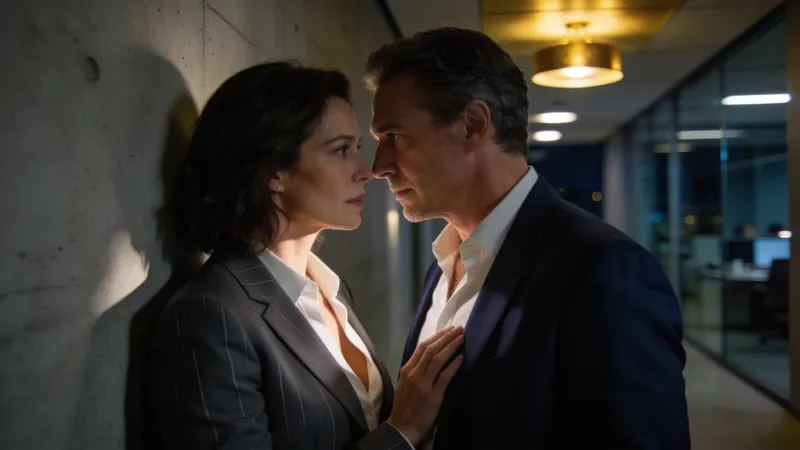
Morning came with sterile light and the click of heels down polished hall. Thalia walked into the conference room at Global Harmonics with her spine straight, her folder balanced, her expression neutral. She didn’t see him at first, just the file on the table, bold letters stamped across the cover: Performance Review.
Then she looked up.
Javier Moss, 33, innovation consultant, sat slouched in a chair like he’d been born leaning. His curls were wilder in daylight, his linen shirt wrinkled as if he’d slept in it. And he was smiling. Not polite. Not professional. A slow, knowing curve of lips that said, I saw you. I felt you. You trembled.
Her breath stalled.
He held her gaze, unapologetic. The file in his hands bore the same title as the workshop’s final exercise. The air between them thickened, charged with everything unsaid. He didn’t move. Didn’t speak. But his thumb brushed the edge of the file, once, deliberate, and she remembered the touch of that same hand on her cufflink, the warmth of his voice in the dark.
Across the table, her boss cleared his throat. “Thalia, this is Javier. He’ll be assessing our team dynamics. Starting with yours.”
She nodded, voice steady despite the storm beneath. “I look forward to it.”
And she did. Not to the review. To the reckoning. Because he knew her secret. And worse, she feared he hadn’t let go of her either.
That night, she stood again before the unmarked door, her reflection warped in its tarnished brass. Inside, the lights would be low. The voices hushed. But this time, she wouldn’t hide. This time, she’d walk in knowing exactly who waited for her, and what he’d already taken without asking.
The knob turned under her hand.
Chapter 2: Confessions in the Dark
Thalia stepped into the hush of the room, the door sealing behind her with a soft click that echoed in her ribs. The air was warm, laced with sandalwood and the faintest trace of salt: someone’s skin, maybe, or a candle long since burned out. She didn’t look for him. Not yet. She let the dimness settle over her like a second skin, the only light coming from a single lantern in the corner, its flame flickering against the walls like a pulse.
Across the circle, the facilitator raised a hand. “Tonight, we remove the eyes. Blindfolds on. And when I ask you to speak, you will do so as your character, but only truth. No lies. No performance.”
A murmur rippled through the room, low and nervous. Thalia exhaled, long and slow, as the black silk was tied behind her head. The world narrowed to sound, to breath, to the weight of her own heart thudding beneath her ribs. She was The Archivist again. Keeper of secrets. Guardian of the vault. But tonight, the lock was rusted. The hinges loose.
She felt him before she heard him. The shift in the air. The warmth blooming at her side as he sat beside her, close enough that the sleeve of his shirt brushed her forearm. Javier. She knew it in her bones, in the way her skin hummed at his nearness, in the rhythm of his breathing, just a fraction too fast, just like hers.
“Speak,” the facilitator murmured. “Tell us what your character fears.”
Thalia swallowed. Her voice, when it came, was a whisper wrapped in velvet. “I’m afraid of being weak. Of what happens when I stop holding on. Control is the only thing that keeps me from falling apart.”
Silence. Then his voice, low and rough, as The Intruder. “I don’t know who I am without the act. I’m always playing a part. Smiling, joking, moving, anything to keep stillness from catching me. If I stopped… I’m afraid nothing would be left.”
She turned her head toward the sound, blindfolded, breath caught. That voice: she’d heard it in meetings, slick and polished, tossing off quips like confetti. But this? This was raw. Real. A crack in the façade, and she ached to press her palm over it.
The facilitator’s voice cut through. “Now, reach out. One hand. Let it find the other’s. No words. Just touch.”
Her fingers trembled as she lifted them. A beat. Then his skin met hers, warm, calloused at the edges, tentative. She curled her hand into his, and he did the same, their palms pressing, fingers interlacing like roots finding soil.
“I saw you,” he murmured, so low she might have imagined it. “Even in the dark.”
She didn’t answer. Couldn’t. The truth of it filled her chest, too vast to speak. But she squeezed his hand, once, and felt him squeeze back.
When the blindfolds came off, no one spoke names. They never did. But she saw him. Really saw him. The shadows under his eyes, the way his throat worked when he looked at her. The way he didn’t look away.
Later, sunlight. Her office, sterile and precise, the hum of the AC a steady drone. A knock. She looked up.
Javier stood in the doorway, file in hand, wearing a shirt that looked like he’d wrestled it into submission. No tie. No pretense. He stepped inside, closed the door behind him.
“You left something behind,” he said, and placed her silver cufflink on the desk.
Her breath caught. She reached for it, but he didn’t move. Just watched her, steady.
“Thank you,” she said, voice careful. Professional. “I didn’t realize.”
“You didn’t,” he said softly. “You were too busy running.”
She looked up then, met his gaze. “And you?”
“I stayed. I waited.”
The air between them thickened, charged. Not with threat. With possibility.
That night, she returned to the unmarked door. This time, she didn’t hesitate. This time, she walked in knowing exactly who waited for her, and what she wanted.
They were paired again. No blindfolds. No roles. Not really.
The facilitator’s voice was gentle. “Choose a new scenario. One of mutual surrender.”
Javier turned to her. “Do you want to try?”
She nodded.
They sat across from each other, knees nearly touching. The exercise was simple: speak a truth, then touch. A hand on a wrist. A palm on a cheek. A thumb brushing a collarbone. Each gesture earned a confession. Each confession earned a deeper touch.
“I’ve never let anyone see me cry,” she said, and he pressed his palm to her shoulder, warm and sure.
“I pretend I don’t care so no one sees how much I do,” he said, and she reached out, traced the line of his jaw with her fingertips.
The space between them collapsed slowly, inevitably. Then he leaned in, and she met him halfway.
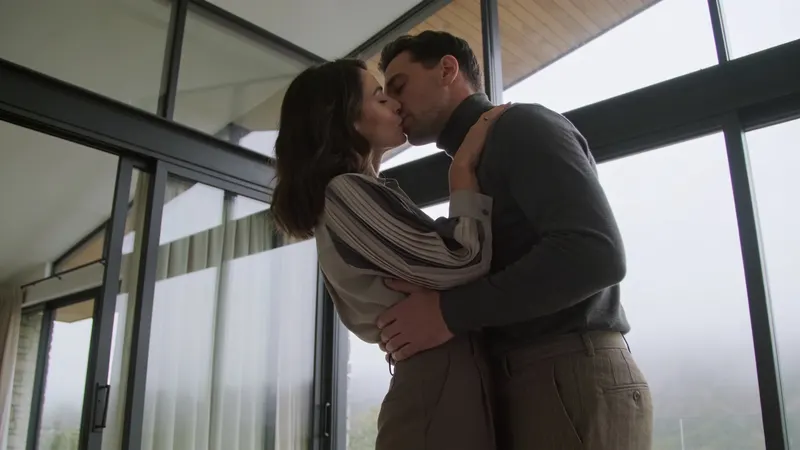
Their kiss was not tentative. It was a claiming, a release. His mouth moved over hers with a hunger that matched her own, hands sliding to her waist, pulling her close. She gasped into him, fingers tangling in his curls, holding on as if he were the only solid thing in a world gone liquid.
“Tell me what you want,” he murmured against her lips.
“You,” she breathed. “Just you.”
“Say it again.”
“You. Don’t stop.”
His hands slid up her back, under her blouse, skin to skin. She arched into him, a moan catching in her throat. The line between role and reality had not blurred. It had burned away.
Later, in the dark of her apartment, she woke alone. The sheets were warm where he’d been. The memory of his hands on her skin, his mouth on her neck, his voice whispering I see you, vivid, relentless. But the bed beside her was empty.
And the performance review deadline loomed, a red flag on her calendar, forcing her to decide: report their encounter, uphold protocol, retreat behind the wall she’d spent years building, or protect the fragile, trembling truth that had bloomed between them, still breathing, still possible.
Chapter 3: The Real Review
Thalia sat at her desk, the incident report half-typed, the cursor blinking like a heartbeat on the screen. Violation of professional boundaries. Unauthorized personal interaction between HR and external consultant. The words felt like stones in her mouth, heavy and false. Outside, San Francisco stretched in its usual fog-draped calm, but inside her, everything trembled.
She reached into her pocket and pulled out the crumpled workshop feedback slip, the one-handed to her anonymously at the end of the second session. The handwriting was jagged, urgent. I saw you. And I was seen. She pressed the paper to her chest, just over her heart, as if it could steady the rhythm.
A knock at her door. Her assistant, voice muffled. “Ms. Grant, Javier Moss is here. He says it’s about the innovation proposal.”
She didn’t answer right away. She smoothed the paper, tucked it into her desk drawer, next to the silver cufflink he’d returned, cold and bright against the wood. Then she exhaled. “Send him in.”
Javier entered in a linen shirt sleeves rolled to the elbows, his curls slightly wilder than usual, as if he’d run his hands through them one too many times. He carried a manila folder, but his eyes went straight to hers, searching. No smirk this time. No deflection.
“I submitted the proposal,” he said. “But I wanted to give you this in person.” He placed a folded note on her desk.
She didn’t move. “You know we can’t…”
“I know.” He cut her off gently. “I know what you’re thinking. That this is a conflict. That we should report it. That we should walk away.” He paused. “But I don’t want to pretend anymore. Not with you.”
She looked down. The note. Her fingers hovered.
“Open it,” he said.
She did. Three words, written in the same jagged hand as the feedback slip. The most disruptive idea is honesty.
Her breath caught.
“I’m not here to charm you,” he said. “I’m not here to play the consultant or the Intruder or whatever role you think I’m performing. I’m here because I meant what I said in the dark. I’ve spent my life making people laugh, making them lean in, making them believe I’ve got it all figured out. But with you, I don’t want to be believed. I want to be known.”
Thalia stood, slowly. The air between them thickened, not with tension, but with something deeper: recognition.
“And what if I’m not who you think I am?” she asked, voice low. “What if I’m not strong? What if I fall apart?”
“You already did,” he said. “And I didn’t look away. I stayed.”
She remembered the blindfold, the tremor in her voice, the way she’d whispered I’m afraid of being weak and he hadn’t laughed, hadn’t recoiled. He’d said, Then let me hold you.
Now, in the light, he held out his hand. Not demanding. Offering.
“I want to see you again,” he said. “Not as the Archivist. Not as HR Director. Just you. If you’ll let me.”
She looked at his hand. Then at the report still glowing on her screen. The protocol. The safety of the wall.
She closed the laptop.
And took his hand.
They walked in silence to the unmarked door in the Mission District, the same one she’d hesitated at two weeks ago. This time, she didn’t pause. She turned the handle and stepped inside.
No roles. No names. No fiction.
Just the dim light, the scent of sandalwood and skin, the quiet hum of breath in the dark.
Javier turned to her. “Do you want to run a scenario?”
She shook her head. “No. I want to be here. With you. As us.”
He smiled: small, real, nothing performed. “Then that’s what we’ll do.”
He cupped her face, slow, reverent. His thumb brushed her cheekbone, the place where, in another life, she’d let a single tear fall. He leaned in, and this kiss was nothing like the claiming of before. It was an arrival. Soft. Certain. Full of return.
Her hands slid up his chest, feeling the steady beat beneath cotton and skin. He murmured her name, Thalia, like it was a vow, like he’d been waiting years to say it right.
They undressed each other with deliberate care, not urgency, each button, each slide of fabric a kind of confession. His shoulder bore a small scar, pale against warm brown skin. She traced it. “How?”
“Bike accident at twenty-three. I didn’t tell anyone I was hurt. Kept smiling through the meeting.”
She kissed it. “I’m sorry you were alone.”
He exhaled, a shudder running through him. “I’m not anymore.”
When they came together, it was slow, a joining, not a collision. He entered her with a breath, a pause, his forehead resting against hers. “Look at me.”
She did.
“Tell me you’re here.”
“I’m here,” she whispered. “I’m not hiding.”
He moved, gentle at first, then deeper, each thrust a kind of truth. She arched against him, nails lightly scoring his back, not to take, but to feel. To confirm.
They spoke in fragments. Yes. Like that. Don’t stop. I’ve got you. No roles, no lines: only the raw, tender music of two people choosing each other, fully, for the first time.
After, they lay tangled in the quiet, sweat cooling on their skin, breath syncing. He traced circles on her hip. She rested her head on his chest, listening to the rhythm that had once been a mystery.
“I was afraid,” she said, “that if I let go, there’d be nothing left.”
“There’s everything left,” he said. “More, even.”
She smiled, eyes closed.
Later, alone in her office, she opened the drawer. Took out the cufflink. Then reached for a fresh file, blank except for the title she typed with steady hands: Revised Policies: Emotional Integrity.
She placed the cufflink inside. Not as a relic. As a beginning.
The next morning, she walked into the conference room, Javier beside her. The same table where they’d first seen each other, masks still intact. Today, their shoulders brushed. Then, just before he stepped away, his fingers found hers, once, deliberately, warm, sure, a silent promise.
They let go.
But not really.
The end
Editorial collection: The Velvet Collection
Related stories