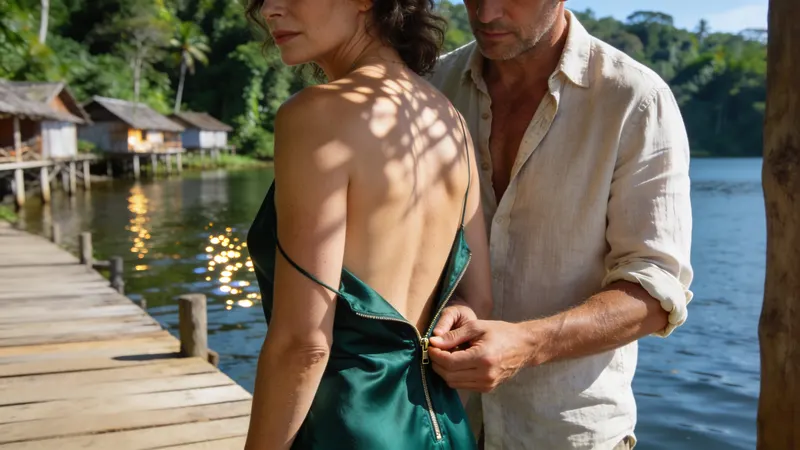
The Dialect That Kept Their Secret
Synopsis
A 45-year-old linguist and a 39-year-old documentary filmmaker meet in the Brazilian Amazon, where isolation and urgency deepen their slow-burn connection. As they race to preserve a dying dialect, their emotional intimacy gives way to a passionate, consensual affair. Set against the humid pulse of the jungle, this is a story of forbidden desire, linguistic beauty, and the sensual stories told through touch.
What to expect
- Tension between professional duty and personal desire
- A slow-burn romance deepened by emotional and linguistic intimacy
- Consensual, explicit encounters woven with sensory detail
- A lush, immersive setting that mirrors inner passion
- Powerful emotional and physical connection between mature leads
Tropes: Strangers, Slow burn, Workplace romance, Forbidden romance
Story details
| Chapters | 3 |
|---|---|
| Reading time | 15 min |
| Spice level | 4/5 |
| Rating | – |
| Reads | 1 |
| Status | Complete |
| Published | |
| Updated |
Chapter 1: First Words
The motorized canoe cut through the glassy surface of the blackwater river, its engine sputtering in rhythm with the heartbeat of the forest. Lina Mendes adjusted the strap of her leather satchel, fingers brushing the worn cover of her journal. At 45, she’d learned to travel light, both in luggage and in expectation. The humid air clung to her skin as the village emerged from the mist: a cluster of stilted huts with palm-thatched roofs, smoke curling into the late afternoon sky like a whispered invitation.
She stepped onto the wooden dock, her boots sinking slightly into the damp planks. No voices greeted her, no curious faces appeared at doorways. Only the village elder, a man named Yaraçu stood waiting beneath the communal lodge’s overhang, his face etched with the quiet dignity of someone who had outlived most of his world. He spoke in the dialect she had spent two years studying, soft, tonal, with glottal stops that resisted transcription. She answered in kind, her Portuguese-accented pronunciation careful but fluent. A flicker of surprise, then approval, crossed his weathered features.
Inside the dimly lit lodge, shadows danced on the bamboo walls. And there, crouched beside a tripod, adjusting the lens of a weathered camera, was a man she hadn’t expected.
Thibault Moreau. She recognized him from his films—Whispers of the Caribou, Salt and Silence—works that treated cultures not as spectacles but as living breaths. He rose slowly, wiping his hands on his jeans. Late thirties, she guessed. Dark hair dusted with river sand, eyes the color of wet clay, deep, watchful. He introduced himself in Portuguese, his French-Canadian accent curling around the syllables like smoke.
“I didn’t think anyone else would come this far in,” he said.
“Neither did I,” she replied, and something in the symmetry of their solitude hung between them.
Yaraçu gestured for them to sit. Over bitter tea brewed from jungle herbs, he explained the purpose: the language, known only to nine elders now, would likely die with them. Lina was to document its structure, its songs, its untranslatable words, those that held whole histories in single syllables. Thibault would film the people, their gestures, the way their voices softened when speaking to grandchildren who no longer understood.
They agreed to work together. She would record audio; he would capture images. Their collaboration was practical, efficient. Yet as they walked into the forest the next morning, machetes clearing a narrow path through the undergrowth, Lina felt the quiet weight of his presence behind her. He didn’t speak much, but when he did, his voice was low, deliberate, as if measuring each word before release.
The forest breathed around them, monkeys chattering high in the canopy, the rustle of unseen creatures beneath the leaf litter. They stopped beside a kapok tree, its roots sprawling like the limbs of an ancient god. To record an elder’s recitation of a hunting chant. Thibault filmed from a slight distance, his lens focused on the man’s hands, the way they moved like water over air.
Then the sky cracked open.
Rain fell in sheets, sudden and total, turning the path to sludge. The elder hurried back toward the village, but Lina and Thibault were too far behind. They ran, slipping on wet roots, until they reached the broad, umbrella-like leaves of a gigante tree, its canopy thick enough to repel the downpour.
They stood close, shoulder to shoulder, beneath the green vault. Water dripped from Lina’s braid, soaked through the cotton of her shirt. Thibault removed his pack, setting it aside, then shrugged off his jacket, offering it without a word. She hesitated, then accepted. The fabric warm from his body, smelling of salt and camera oil.
“Thank you,” she said, her voice barely above the rain.
He nodded, watching her. “You’re shivering.”
“A little.”
He didn’t move closer, but the space between them felt charged, as if the storm had stripped away the formality of their arrangement. She studied his profile: the strong line of his jaw, the faint scar above his eyebrow. He turned, catching her gaze.
“You speak it like you’ve dreamed it,” he said.
“I have,” she admitted. “For years. I’ve spent my life chasing voices that no one else hears. Sometimes I wonder if I’m preserving language, or just collecting ghosts.”
“And does that loneliness ever follow you?” he asked, not flippantly, but with the gravity of someone who knew its shape.
She looked down, fingers tightening on the strap of her recorder. “More than I’d like.”
He didn’t offer comfort. Didn’t reach for her. But something in his silence said he understood.
They stayed until the rain eased, until the forest exhaled and the birds returned. Wordlessly, they made their way back.
That night, the village gathered around a fire. The elders sang in low, resonant tones, their voices weaving through the humid air. Lina sat apart, notebook open, but her pen had stilled. Thibault approached crouching beside her with his, camera in hand.
“May I?” he asked, lifting it slightly.
She nodded.
He didn’t film the fire, or the singers. He filmed her: her face half-lit by flame, the way her lashes cast shadows on her cheeks, the way her lips parted slightly as she listened. She felt exposed, not by the lens but by the care with which he held it.
When the others had gone to sleep, he remained. The fire dimmed to embers. The only light came from a single candle inside the lodge, where they sat on woven mats, speaking in hushed voices.
“Why this language?” he asked. “Out of all the ones vanishing?”
She exhaled, considering. “Because it has a word—aniré—that means ‘the ache of almost remembering a dream.’ There’s no equivalent in any language I know. And when I first heard it, I realized… I’ve felt that my whole life.”
He studied her. “You’re not just translating words. You’re translating longing.”
She met his gaze, something unguarded flickering in her chest. “And what about you? Why do you film people saying goodbye to their worlds?”
He paused. “Because I’ve spent my life watching stories end. Maybe I’m hoping one day, I’ll catch the moment they begin again.”
The silence stretched, tender and taut.
Then, without asking, he lifted the camera once more. The red recording light blinked on, soft, persistent. He angled it toward her, not for the documentary, not for archives. This was separate. Intimate.
She didn’t look away.
The light pulsed like a heartbeat in the dark.
Neither spoke. Neither needed to.
The camera’s red light blinked in the dark, recording more than images. Something unspoken has begun.
Chapter 2: Whispers in Translation
The days unfolded in a rhythm dictated by the elders’ memories and the shifting light beneath the canopy. Lina rose before dawn, her fingers already tracing phonemes in her leather journal by the glow of a kerosene lamp. The language, soft, guttural, threaded with tones that rose like mist off the river, was slipping away, syllable by syllable. Each session with the elders felt like holding water in cupped hands. Thibault filmed with a stillness that bordered on reverence, his camera an extension of his breath. They worked in sync now, their movements choreographed without words: she would prompt an elder with a phrase, he would adjust the frame, catch the tremor in a wrinkled hand, the flicker of recollection in milky eyes.
Between recordings, they walked. Not for necessity, but for the space between sentences. Lina spoke of Lisbon winters, of libraries where silence was measured in footsteps, of colleagues who admired her precision but never asked about the hollow behind her ribs. Thibault listened, his gaze steady, never rushing to fill the pauses.
“I used to think fluency meant understanding every word,” she said one afternoon, pausing beneath a ceiba tree whose roots curled like sleeping serpents. “But now I think it’s about learning how to sit inside the silence between them.”
He nodded. “That’s what film teaches you. The meaning isn’t always in the dialogue. It’s in the glance before it. The breath after.”
She looked at him then, not as a collaborator, not as a stranger, but as someone who might already know the shape of her solitude.
That evening, the air thick with the scent of damp earth and woodsmoke, they made their way to the river. The day’s heat clung to their skin, and the elders had retired early, their voices spent. The water shimmered under a bruised twilight sky, the surface breaking only when a caiman slipped beneath, leaving ripples that trembled outward and vanished.
Lina stepped into the shallows first, letting the cool embrace her calves, then her thighs. She unbuttoned her shirt slowly, folding it over a flat stone, then slipped out of her trousers. The cotton of her undergarments clung as she waded deeper, the current tugging at her hips. She submerged herself, surfacing with a gasp, her braid undone, hair fanning in dark strands around her shoulders.
She didn’t see him watching from the bank at first. Only when she turned did she catch the weight of his gaze, not intrusive, but absorbed. As if he were memorizing the way the fading light caught the droplets on her collarbone, the curve of her spine as she wrung water from her hair.
He began to undress without ceremony, his movements unhurried, deliberate. His shirt fell open, revealing the old scar on his left shoulder, pale against sun-browned skin. He stepped into the water, moving toward her with the quiet certainty of tide.
They didn’t speak. The river spoke for them.
When he was close enough to touch, he paused. Water lapped at their chests, their breaths syncing with the current.
“May I touch you?” he asked, voice low, clear, unshaken.
She looked into his eyes, dark, steady, open. Not hiding. Not demanding.
“Yes,” she said. “If it means what I think it does.”
He lifted a hand, slow, giving her time to retreat. When she didn’t, his fingers brushed a wet strand of hair from her temple, then traced the line of her jaw. His touch was warm despite the water, grounding. She leaned into it, just slightly, and that was all the invitation he needed.
His mouth met hers gently at first, testing, tasting. Then deeper, as if drawing from a well long sealed. She answered with a sigh that turned into a moan, her hands sliding up his arms, over the ridge of his shoulders, fingers pressing into the scar. His tongue slipped between her lips, slow and sure, and she opened for him like a language finally spoken aloud.
They kissed as if translating something too long unuttered, grief, hunger, the quiet ache of being known.
When they pulled apart, breathless, the world had narrowed to the space between their bodies, the heat beneath the surface.
“We should go back,” he murmured, though he didn’t move.
She nodded, but her hand stayed on his chest, feeling the steady drum of his heart.
They dressed in silence on the bank, towels wrapped tight, skin still glistening. The walk to the cluster of tents was short, but charged, a current humming beneath every step.
Inside hers, the air was close, scented with sandalwood oil and damp earth. He hesitated at the flap.
“This is where I ask again,” he said.
She stepped forward, untying the knot of her towel. It fell to the ground.
“Ask,” she whispered.
“May I stay? May I touch you here, now, with nothing between us but truth?”
Her breath caught. She reached for his hand, brought it to her lips, kissed his knuckles.
“Yes. Please.”
He undressed with care, folding each piece as she had, placing them aside like offerings. When he stood before her, bare, she took him in: the breadth of his chest, the trail of dark hair leading down, the quiet strength in his stance. She reached for him, but he caught her wrist gently.
“Let me,” he said. “Let me learn you.”
His hands traced her collarbone, the dip of her waist, the swell of her hips. Each touch a question. Each pause a space for her to say no.
“Is this okay?” he murmured, fingers skimming the side of her breast.
“Yes,” she breathed.
“And this?”
His palm cupped her fully, thumb brushing her nipple, already taut in the warm air.
“Yes.”
He kissed her again as he lowered her to the mat, their bodies aligning with a sigh. His weight was welcome, not crushing. She wrapped her legs around his hips, pulling him closer, feeling the hard length of him press against her thigh.
“Tell me if anything isn’t right,” he whispered against her neck.
She arched into him. “Everything is right. You are right.”
He entered her slowly, inch by inch, watching her face, waiting for her signal. She gasped, then relaxed, her muscles yielding, welcoming.
“Yes,” she said, her voice thick. “Just like that.”
He moved with a patience that unraveled her: deep, measured strokes, each one drawing out a new sound from her throat. She met him, lifting her hips, urging him deeper, her nails scoring lightly down his back.
“Thibault,” she gasped, her body tightening around him. “Don’t stop. I’m close.”
He kissed her, swallowing her cry as her release took her, wave after wave, silent except for the hitch of her breath. He followed moments later, his groan muffled against her shoulder, his body shuddering as he emptied into her.
They lay tangled, sweat-slicked, hearts pounding in sync. The jungle hummed beyond the canvas: crickets, frogs, the distant rustle of leaves. No children’s laughter, no voices, just the breath of the forest and the two of them, suspended in the quiet after revelation.
Lina traced the scar on his shoulder, her fingers light. “How did you get this?”
He went still, just for a breath. Then exhaled.
“A different life,” he said. “A different silence.”
His answer hung in the humid air: there’s more to Thibault than the lens has shown.
Chapter 3: The Last Word
The jungle exhaled around them, thick with the scent of damp earth and night-blooming jasmine. Lina lay with her head on Thibault’s chest, listening to the steady rhythm of his breath, the slow return of his heartbeat to rest. Sweat still glistened on their skin, cooling in the humid air that slipped through the flaps of her tent. Beyond the thin barrier of canvas, the Amazon pulsed: crickets thrummed in the undergrowth, frogs called from the riverbank, and the leaves stirred in a breeze that carried the quiet breath of the forest.
No voices. No footsteps. Just this: the two of them, wrapped in silence that felt sacred.
She lifted her head slightly, studying his face in the dim light filtering through the tent fabric. The sharp line of his jaw, the faint shadow of stubble, the way his lashes cast delicate shadows on his cheeks. She traced the scar on his shoulder again, not pressing, just remembering the texture of it beneath her fingertips. “A different silence,” she repeated softly, testing the words.
He turned his head toward her, his eyes dark and unreadable for a moment. Then he reached up, brushing a damp strand of hair from her temple. “I was in the Congo,” he said, voice low. “Filming a community displaced by mining. We were ambushed at a checkpoint. A stray bullet. I was lucky.” He paused. “The silence after, it wasn’t just the absence of sound. It was the absence of meaning. Like the world had gone mute.”
She swallowed, her throat tight. “And now?”
“Now,” he said, his hand sliding down to rest at the small of her back, “I’m learning to listen again. Not just with the microphone. With everything.”
She kissed him, slow and deep, tasting salt and truth. When she pulled back, her fingers lingered on his lips. “You see people,” she whispered. “Not just subjects.”
“And you,” he said, “you hear voices others have stopped believing in. That takes courage.”
She didn’t answer. Instead, she pressed her palm flat against his chest, feeling the steady beat beneath. They had spent days gathering the last words of a dying language, preserving stories that would outlive their speakers. And now, here, in the aftermath of their own quiet revelation, she wondered if love could be recorded too—not in files or footage, but in the weight of a glance, the curve of a hand, the way a breath caught when a name was spoken just so.
The next morning passed in a haze of preparation. The elders had gathered in the communal lodge, their faces lined with years, their voices softer now that the final myth had been told. Lina reviewed her recordings, backing up the files onto two separate drives. Thibault adjusted his camera settings, transferring footage in silence. Neither spoke of what had happened, but it hummed between them, present in every glance, every accidental brush of fingers when passing a notebook or a water bottle.
That evening, the village hosted a farewell feast. Banana leaves were spread on long wooden tables, piled with grilled fish, manioc, and tropical fruit. The air filled with laughter and song, the elders chanting in their native tongue, a language that would live on, preserved, even if no one ever spoke it again. Lina sat beside Thibault, their shoulders touching. He passed her a cup of fermented fruit drink, their fingers brushing.
“To memory,” he said softly.
She clinked her cup against his. “To listening.”
Later, under a sky streaked with stars, they walked barefoot to the riverbank. The water shimmered under the moonlight, silver ripples moving with the current. This was where he had first asked permission. Where she had said yes. Where the world had shifted.
He turned to her, cupping her face in his hands. “I’ve been offered a long-term project,” he said. “Mongolia. It starts in six weeks.”
She nodded, her chest tight. “I’m due back in Lisbon. My publisher’s waiting.”
Neither asked the other to stay. They didn’t speak of promises or plans. Instead, Thibault stepped closer, his breath warm against her lips. “May I kiss you?” he asked, just as he had before, respectful, deliberate.
She smiled, her heart swelling. “You already know the answer.”
He kissed her, slow at first, then deeper, as if memorizing the shape of her mouth. She wound her arms around his neck, pulling him into her, the taste of mango and salt on his lips. Their clothes came off with quiet urgency, folded and placed on a flat stone. The night air kissed their bare skin as they stepped into the shallow water, the river cool against their heated bodies.
He lifted her, and she wrapped her legs around his waist, anchoring herself to him. The water swirled around them, gentle, supporting. He entered her with a groan, his forehead pressed to hers, his breath ragged. “Look at me,” he whispered.
She did. Her eyes locked with his as he moved, deep, steady, filling her completely. Each thrust was a word unspoken, a vow unmade but felt. She arched against him, her body tightening, her breath coming in short gasps. “Thibault, yes, just like that, don’t stop.”
He held her tighter, his rhythm increasing, driving her toward the edge. When her release came, it tore through her silently, a wave of heat and light that left her trembling in his arms. He followed moments later, his body shuddering, his cry low and raw against her neck.
They stayed like that, suspended in the water, clinging to each other as the stars blinked above.
Back on shore, wrapped in towels, they dressed in silence. The canoe would come at dawn. The world beyond the jungle was waiting.
At first light, as mist curled over the river, the motorized canoe appeared, cutting through the still water. Thibault helped her aboard, then paused. From his bag, he pulled a sealed envelope, cream-colored, hand-tied with thin red thread.
“For you,” he said.
She took it, her fingers trembling slightly. “What is it?”
“A story,” he said. “One I’ve been writing in my head since the first time you looked at me like I wasn’t behind a lens.”
She held it against her chest as the engine roared to life. He stood on the bank, watching her, his hands in his pockets, his expression unreadable.
The boat pulled away.
Only when the village was a distant shadow did she untie the thread and unfold the page.
At the top, in elegant script: The Language of Longing.
Below, a short film script, written in Portuguese, with passages in the vanishing dialect they had spent weeks preserving. A story of two strangers meeting in a train station years apart. Of a glance. A pause. A single phrase spoken in a forgotten tongue. Recognition. Not in words, but in the way they breathed them.
The final line: Some silences are not empty. They are full of what has been, and what might still be.
The envelope rests in her hands, its contents a promise whispered across time and distance.
The end
Editorial collection: The Half-Light Collection
Related stories