Two Hundred Years Before Her Hand
Synopsis
A hauntingly sensual paranormal romance with forbidden love, ghostly yearning, and slow-burn intensity. At 38, historian Dr. Celine Voss rents a remote Highland estate for research but finds her heart claimed by Lucien, a charismatic spirit trapped since 1814. Their intimate, consensual bond defies time and mortality, blending emotional depth with explicit passion as they confront loneliness, healing, and a love that refuses to stay buried.
What to expect
- A sharp, independent woman in her late thirties reclaiming her desire
- A charming, centuries-old male spirit with deep emotional longing
- A slow-burn supernatural romance charged with erotic tension
- Explicit, consensual encounters that defy physical boundaries
- A moody, isolated manor steeped in history and mystery
Tropes: Slow burn, Forbidden romance, Second chance
Content notes: supernatural intimacy, emotional vulnerability, themes of isolation
Story details
| Chapters | 4 |
|---|---|
| Reading time | 19 min |
| Spice level | 4/5 |
| Rating | – |
| Reads | 0 |
| Status | Complete |
| Published | |
| Updated |
Chapter 1: The First Midnight
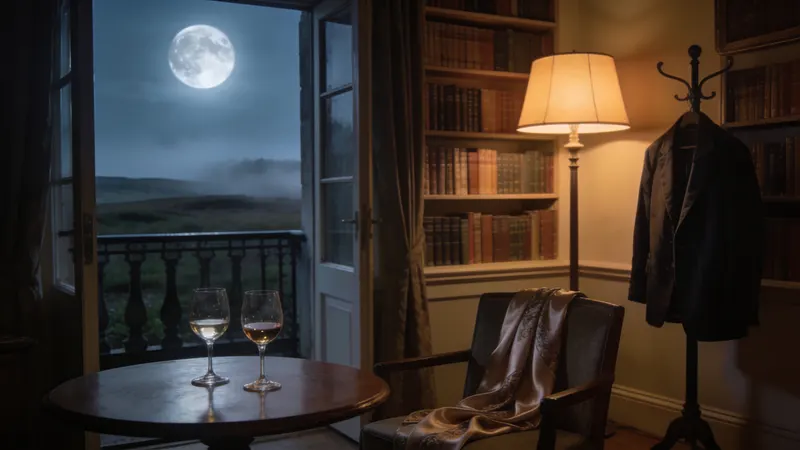
The mist clung to the moors like a secret as Dr. Celine Voss stepped from the car, her boots sinking slightly into the damp gravel drive. The estate loomed before her—stone, weathered, its windows dark and watchful. Glenmoray House. She had chosen it for its isolation, its silence, its untouched archives. At thirty-eight, she no longer needed noise or company. Only space. Space to finish her book on 19th-century spiritualism, to prove to herself and the academic world that she could still produce something meaningful after the wreckage of her last relationship—after Daniel’s quiet dismissal, the way he’d said, You’re too intense, Celine. Too much. As if passion were a flaw.
She carried her bags inside, the heavy oak door closing behind her with a finality that echoed through the hall. The air smelled of old paper, beeswax, and something fainter—woodsmoke, perhaps, though no fire had been lit. The housekeeper, a woman with kind eyes and a brisk manner, had left tea steeping in the library. Your favorite, missus—Darjeeling with a twist of lemon. Celine hadn’t mentioned her preference. She hadn’t told anyone.
The library was vast, lined with mahogany shelves that reached toward a vaulted ceiling. A single armchair faced the cold hearth, its fabric worn but dignified. She set her things down, lit a candle on the desk, and began unpacking. But as night fell, so did the silence deepen, until it wasn’t silence at all. A low hum, almost imperceptible, pulsed through the floorboards, rising from the walls themselves. It wasn’t electrical. It wasn’t natural. It was aware.
At midnight, she sat at the desk, reviewing her notes, when the air before her shimmered. Not a flicker, not a trick of the candlelight—but a slow coalescence, like mist forming into bone and breath. A man stepped forward from nothing. Tall, broad-shouldered, dressed in the tailored black coat of the early 1800s, his cravat precise, his dark hair swept back from a face that might have been carved from marble. His eyes—deep, knowing—held hers without apology.
“You’re later than I expected,” he said, his voice low, resonant, touched with an accent she couldn’t place—French, perhaps, but softened by time.
Celine’s breath caught, but she didn’t rise. Didn’t scream. “You’re not real.”
“I am,” he replied, “as real as you allow me to be.”
“You’re a hallucination. Stress. Isolation.”
He smiled slightly, stepping closer. “Then why did I know you’d arrive at seven past six? Why did I prepare your tea just as you like it—hot, steeped two minutes, lemon on the side? And why, Dr. Voss, do I know that your doctoral thesis on Mesmer’s influence on Romantic-era poetry was published in The Journal of Occult History, volume forty-two, page one-ninety-three?”
Her fingers tightened around her pen. “That’s not—no one has that information. Not unless they’ve read my CV.”
“I’ve read more than that,” he said softly. “I’ve read you.”
The air between them thickened. Not with threat, but with something else—curiosity, recognition. She studied him, the historian in her reasserting control. “Lucien de Montclair. Born 1794. Died 1814. French nobleman, poet, accused of treason during the Bourbon Restoration. You were imprisoned at Château d’If, but your body was never recovered. Official records list you as presumed dead.”
He inclined his head. “You’ve done your research.”
“And you’re supposed to be a footnote. A rumor. Not—” She gestured, helpless, at his form, solid yet undeniably translucent, glowing faintly at the edges like dawn on glass.
“Not standing before you?” He took another step. “I’ve waited for someone who would see me. Not flee. Not gawk. Someone who would know.”
“Why me?”
“Because you study the unseen,” he said. “Because you believe in what others dismiss. And because,” he added, softer now, “you’ve been lonely in the way I have. Not from lack of people. From lack of being seen.”
She exhaled, her chest tight. No one had ever said that to her. Not Daniel. Not her colleagues. Not even her closest friend.
They spoke then of history, of philosophy, of the thin veil between life and memory. He quoted Baudelaire in flawless French, then Byron in English so rich it felt like velvet. He challenged her theories on spiritual automatism, citing a text she’d only just discovered in a private collection. He knew things no living person could.
And then, quietly, he said, “May I touch your hand?”
She froze. “You—what?”
“I wish to take your hand. With your permission.”
Her pulse thundered. This was madness. And yet—she had spent her life denying sensation, retreating into intellect, letting men like Daniel define desire as something loud, crude, fleeting. But this—this was different. This was asked.
She looked at him. At the longing in his eyes, centuries deep. At the way his fingers hovered, not demanding, only hoping.
“Yes,” she whispered.
His hand moved slowly, deliberately. When his fingers brushed hers, warmth flooded her, not heat, but life, a current that arced from her palm up her arm, settling low in her belly. She gasped. It wasn’t illusion. It was sensation, pure and undeniable.
She pulled back, trembling.
“I’m sorry,” he said at once. “Too much—”
“No.” She held up a hand, catching her breath. “No. It’s not that. It’s just… no one’s ever touched me like that. Like I mattered.”
He gazed at her, still. “Then let me keep learning how.”
And then he was gone, dissolving into light, leaving only the scent of old parchment and cedar.
Alone, she sat in the silence, fingertips pressed to her lips, remembering his voice, his presence, the way his touch had felt like coming home. The grandfather clock struck one.
She didn’t move. Didn’t sleep. Just stared at the empty armchair across from her, where shadows pooled too deeply.
The candle flickered.
The armchair across from her filled with a faint shimmer, and a whisper brushed her ear: You’re not afraid. You’re curious.
Chapter 2: The Language of Touch
The armchair across from her filled with a faint shimmer, and a whisper brushed her ear: You’re not afraid. You’re curious.
Celine didn’t flinch. She exhaled slowly, the breath trembling out of her as if she’d been holding it for years. Her fingers curled around the edge of the desk, grounding herself in the solidity of wood and ink-stained paper. But her eyes, steady, wide, alive, never left the figure coalescing before her.
Lucien stepped forward, not from shadow but from between, as though the air itself had parted to let him through. He was dressed as before, in the tailored coat of a man from another century, but something about him had changed. Not in his appearance, his dark hair still fell just above his collar, his eyes still held that depth of time, but in the way he carried himself. Lighter. Hopeful.
“You came back,” he said, voice low, reverent.
“I told you I would,” she replied, and realized her voice had softened, shaped by something she hadn’t felt in years: anticipation.
He smiled, just slightly, and took a seat across from her, not in the armchair where he’d first appeared, but in the one she’d pulled closer to the fire. A gesture. An offering. He folded his hands in his lap, the ghost of a scholar, the poet he claimed to be.
“You’re not what I expected,” she admitted.
“And what did you expect, Dr. Voss?”
“Coldness. Obsession. A spirit trapped in repetition, feeding on sorrow.” She tilted her head. “Not… this.”
“This?”
“A man who listens.”
He stilled. “You’re the first who’s ever said that to me.”
Silence settled between them, not empty but full, like the hush before a symphony begins. Outside, the wind combed through the heather, and the fire cracked, sending embers spiraling.
They spoke then, not of hauntings or history but of ideas. Of Schopenhauer’s melancholy and Whitman’s wild joy. Of how desire was not merely flesh but a reaching, a hunger for recognition. He spoke of the rituals of the dead, how some spirits lingered not from unfinished business, but from unfelt love. How a soul could remain bound not by curse but by the weight of a single, unspoken name.
“I was a poet,” he said quietly. “Not a famous one. But I wrote for the sake of truth. For the curve of a woman’s smile at dawn. For the ache of losing something before you even had it. I was accused of treason, falsely. The charge was absurd, but the court was eager. I made a vow before they took me. I don’t remember the words, only the weight of them. And the certainty that I would not leave until I saw you again.”
Her breath caught. “We’ve met before?”
“In another life. Perhaps many. I don’t know. But I’ve felt you, fleeting, distant, like a melody half-remembered. And now… now you’re here. Flesh and bone and fire.”
She looked down at her hands. “I haven’t always been allowed to feel that fire.”
He waited.
“My last lover,” she said, choosing the words carefully, “said I was too much in my head. That I was cold. Detached.” She gave a dry laugh. “He preferred women who performed passion. I preferred to feel it. But he didn’t have the patience.”
Lucien’s expression darkened, not with anger, but with sorrow. “Then he did not see you. And if he did not see you, he never touched you at all.”
She looked up, startled by the certainty in his voice.
He leaned forward, the firelight catching the silver in his eyes. “May I show you what you were never allowed to feel?”
Her pulse leapt. The air thickened, charged, as if the room itself was holding its breath.
She could have said no. She could have stood, retreated to her room, buried herself in research. But she had spent too many nights pretending she didn’t ache. Too many mornings pretending she didn’t dream.
“Yes,” she breathed.
He raised a hand, not to touch her, but to offer. A soft light began to swirl between them, golden and warm, like sunlight caught in dust. It curled around her wrists, her shoulders, settling like breath on skin.
Then warmth. Not on her hand this time but on her neck.
She gasped.
It was the lightest pressure, a phantom caress just below her ear, trailing down the column of her throat. Her breath shuddered. She hadn’t been touched here in years, not like this, not with reverence. The sensation spread, ethereal fingers tracing the slope of her collarbone, the hollow between her breasts, the curve of her waist. It wasn’t physical, not in the way of hands or lips, but it was real, more real than any touch she’d known.
She arched into it, helpless. A moan slipped from her, low and unguarded.
“Lucien.”
“Shhh,” he whispered, though his voice was inside her mind as much as in the room. “Just feel.”
The warmth intensified, not toward climax but through it, waves of sensation building without demand, peaking in a silent crescendo that made her thighs clench and her vision blur. It wasn’t sex as she’d known it, rushed, performative, but something deeper, slower, truer. A recognition. A homecoming.
When it passed, she trembled, arms wrapped around herself, breath ragged.
He was silent, watching her with a tenderness that made her chest ache.
“Are you alright?” he asked.
She nodded, still dazed. “I’ve never, no one’s ever.” She swallowed. “It felt like being known.”
He closed his eyes briefly, as if savoring her words. “Then may I do it again?”
She looked up, met his gaze, and whispered, “Again, please.”
He hesitated. “Only if you’re certain.”
“I’ve never been more certain of anything.”
This time, when his hand moved, she reached for him too.
Her fingers stretched into the space between them, not knowing if they would pass through or meet resistance. And then, contact. Not cold. Not empty. Her hand met his in midair, palm to palm, fingers intertwining.
A flare of golden light erupted, silent and radiant, flooding the room. The fire roared. The air hummed.
And every book on the shelves began to glow, their pages turning on their own as the air thickened with energy.
Chapter 3: The Vow Unspoken
The library pulsed with a quiet, living light. The books still glowed faintly, their pages slowly settling, as if catching their breath after the surge of energy. Celine sat in the armchair, her hand still outstretched, trembling slightly. Lucien’s fingers were no longer there, but the warmth of their connection lingered in her skin, in her bones, like the echo of a heartbeat not her own.
She exhaled, long and slow, and rose from the chair. This time, she didn’t come at midnight. She came at seven, before the sun had fully crested the Highland hills, before the mist had burned away from the moor. She wore a soft cashmere sweater the color of heather at dusk, her dark hair unbound, falling past her shoulders in loose waves. No notepad. No pen. No armor of academia.
She had come to be seen.
The fire had died to embers, but it flared the moment she stepped inside, as though the house itself recognized the shift in her. She turned as the air shimmered near the hearth, and there he was.
Lucien.
He stood in the same clothes as before, tailored coat, cravat, waistcoat, but tonight, they seemed less like a relic and more like an extension of him. His dark eyes held hers with a gravity that made her breath catch. He smiled, small and tender.
“You came early.”
“I wanted to,” she said, voice softer than she intended. “I didn’t want to wait.”
He stepped forward, not quite solid, not quite shadow, but something in between. The space around him hummed, charged with the same golden energy that had flared the night before.
“You’re different tonight,” he observed.
She crossed her arms, not from defense, but from the sheer vulnerability of being known. “I think I’m finally letting myself feel it. What’s happening between us. It’s not just fascination. It’s not just history. It’s…” She paused, searching for the word. “Recognition.”
He exhaled, as if he’d been holding his breath for two centuries. “Yes,” he said simply. “Soul to soul. I felt it the moment you stepped into this house.”
They moved toward each other, stopping just short of touching. The air between them shimmered, warm and thick with potential.
“You said you were bound by a vow,” she whispered. “But you didn’t know the truth of it.”
He looked down, then back at her. “I believed it was a curse. That I was trapped here for a crime I didn’t commit. But now I see it wasn’t punishment. It was a promise. A choice.” He reached up, his translucent fingers hovering near her cheek. “I swore to remain until the one who sees me, truly sees me, arrived. Not my form. Not my name. But me. And you do.”
Her throat tightened. “You’ve been waiting for me?”
“Across lifetimes,” he said. “I didn’t know it was you at first. But when you spoke of longing in your work… when you stirred the dust in this library with your quiet grief… I knew.”
She stepped closer. “What would it take to free you?”
“I don’t know,” he admitted. “But I fear it’s not just knowledge. It’s action. A ritual. A vow spoken in this place, at the right hour.”
She nodded, absorbing it. “Then we’ll find it.”
His eyes searched hers. “Why are you so certain? You could walk away. Return to your world. Your logic. Your safety.”
She smiled, faint but sure. “Because for the first time in years, I don’t feel cold. I feel awake. And not just because of what you do to me.” She reached up, mirroring his earlier gesture. “But because of what you see in me.”
They stood in silence, the space between them charged with something deeper than desire, something ancient, tender, inevitable.
Then she whispered, “May I touch you?”
His breath caught.
“You don’t have to ask,” he said.
“I want to,” she replied. “I want to give you this. On my terms. With my consent. Fully.”
He nodded, eyes dark with emotion.
She lifted her hand, slowly, deliberately. It passed through the air where his chest should be, and for a moment, nothing. Then, just as she was about to pull back, her fingers met resistance.
A beat.
Then another.
A heartbeat.
Strong. Steady. Alive.
She gasped. “Lucien…”
He staggered slightly, his form flickering, then solidifying. His hand flew to his chest, eyes wide with wonder. “I can feel it,” he whispered. “I can feel.”
She pressed her palm harder, feeling the rhythm beneath her fingers, the warmth spreading up her arm. “You’re here,” she breathed. “You’re real.”
He looked at her, tears in his eyes. “Because of you.”
And then he moved.
Not as a spirit. Not as a memory.
As a man.
He cupped her face, his touch no longer ethereal but present, warm and firm. She closed her eyes as his lips met hers.
The kiss was not hesitant. It was not ghostly. It was deep, certain, charged with two centuries of waiting, of longing, of love denied. His mouth moved over hers with a reverence that made her knees weak, and she leaned into him, one hand still on his chest, feeling the steady drum of his heart.
When they parted, they stayed close, foreheads touching, breath mingling.
“I’ve kissed you a thousand times in dreams,” he murmured. “But this, this is the first time I’ve truly felt you.”
She smiled, tears slipping free. “Then let’s make it last.”
“I want you,” she whispered, her voice raw. “Not just like this. Not just moments. I want you fully. However that’s possible.”
He pulled back just enough to meet her gaze. “Then we must uncover the vow,” he said. “Before the next moon. Before whatever binds me tightens again.”
She nodded, still trembling, still reeling from the kiss, from the heartbeat, from the truth of him.
And then.
A sudden chill swept through the room.
The fire died in an instant.
The glowing books darkened.
The library doors, wide open moments before, slammed shut with a force that shook the walls.
Celine turned, heart pounding.
The candlelight flickered once, twice, then vanished.
In the suffocating dark, a voice slithered from the far corner, low and venomous, not Lucien’s.
“She doesn’t belong here.”
A pause.
Then, softer, crueler…
“She will fade like the others.”
Chapter 4: The Bond Beyond Death
The darkness was absolute, but Celine didn’t move. Her breath came fast, shallow, yet her hands, still pressed against Lucien’s chest, remained steady. She could feel him, solid and warm beneath her palms, and that was enough. More than enough. It was proof.
“Don’t let go of me,” Lucien whispered, his voice strained. “Whatever happens, don’t let go.”
She tightened her grip. “I won’t.”
The air thickened, pressing in like a weight. A low hum vibrated through the floorboards, rising into a dissonant chorus of whispers, voices layered over one another, ancient and bitter. Shadows pooled in the far corner, coiling like smoke, then stretched forward in tendrils that slithered across the rug. The entity was forming, not with a face, but with presence, an oppressive intelligence that pulsed with resentment.
“You think love breaks oaths?” it hissed, the voice shifting between genders, ages, tones. “You think she can free you? She is flesh. Flesh fades. Memory unravels. She will forget you, as they all did.”
Lucien stepped in front of Celine, shielding her. “She sees me. Truly. That was the vow.”
“The vow was a lie,” the entity spat. “You swore to wait, but you never believed she’d come. You wanted to be bound. You feared freedom.”
Celine flinched at the cruelty in its words, but she didn’t retreat. Instead, she reached around Lucien, her fingers brushing the pocket of his coat, where she’d slipped the journal earlier, after finding it hidden behind a loose stone in the study’s hearth. She’d read it by candlelight, tears blurring the elegant script as Lucien confessed everything: his name, his crime, his sacrifice. He had taken the blame for his lover’s treason, a woman accused of aiding rebels, knowing she would be executed if he didn’t. He swore an oath not to rest until the one who saw him, knew him, spoke his truth aloud. Not to release him, but to witness him.
And she had.
“I know your truth,” she said, stepping forward, her voice clear despite the tremor in her chest. “Lucien de Montclair. Poet. Patriot. Lover. You gave yourself so another might live. You’ve waited not out of punishment, but out of hope. And I see you. I’ve always seen you.”
The entity recoiled, the shadows writhing. “You don’t belong here!”
“I do,” she said. “Because he does. And I choose him.”
Midnight neared. The grandfather clock in the hall began its slow, sonorous chime.
Lucien turned to her, his eyes luminous even in the dark. “The vow must be spoken. Together.”
She nodded, pulling the journal free. The pages fluttered open to the final entry. She read aloud, her voice gaining strength with each word: “I bind myself not to this house, but to the hope of being known. Until the one who sees my soul speaks my name, I will remain.”
Lucien joined her, his voice blending with hers, deeper, resonant: “Not in sorrow, but in love. Not in death, but in waiting. I am here. I am real. And I am yours.”
The words hung in the air.
Then, light.
Not from candles, not from fire, but from within the walls, the floor, the very air. Golden, pulsing, alive. The books on the shelves flared open, pages turning wildly as if caught in a storm. The entity screamed, a sound that tore through time, through silence, through centuries of jealousy and loneliness, and then unraveled, its form dissolving into ash that scattered on an unfelt wind.
The library doors burst open.
And Lucien gasped.
He staggered forward, not as a spirit, but as a man. Solid. Breathing. Alive.
Celine caught him, her arms wrapping around his shoulders as he collapsed against her, his chest heaving, his skin warm, real. She laughed, weeping, pressing her face into his neck, inhaling the scent of him, woodsmoke, old paper, and something entirely new: blood, breath, life.
“You’re here,” she whispered. “You’re here.”
He lifted his head, his eyes wide with wonder, with disbelief. “I can feel the floor. I can feel your hands. Your heartbeat.”
“I know,” she breathed.
And then they were kissing again, not with the restrained awe of before, but with hunger, with joy, with the sheer, staggering miracle of touch that no longer passed through. His hands, solid, warm, cradled her face, then slid down her back, pulling her against him. She moaned into his mouth, arching into the press of his body, the heat of his thighs, the unmistakable hardness against her hip.
“Celine,” he murmured between kisses, “may I?”
“Yes,” she said, laughing. “Yes, Lucien. Anything. Everything. Just touch me. Feel me.”
He hesitated, just for a breath. “I’ve waited so long. I don’t want to rush.”
“You’re not,” she said, guiding his hand to the hem of her blouse. “You’re coming home.”
They moved slowly, reverently, up the stairs. His steps were unsteady at first, unused to gravity, to breath, to the simple act of walking. She stayed close, her arm around his waist, her shoulder bearing some of his weight, not because he needed it, but because she wanted to.
In her bedroom, she lit a single candle. The flame danced, casting shadows that no longer threatened, only embraced.
He stood before her, watching as she undressed, not with urgency, but with intention. Each piece of clothing laid aside like an offering. When she was bare, she reached for him, unbuttoning his coat, then his shirt, peeling away the layers of time. His body was lean, strong, marked with faint scars she hadn’t seen before, remnants of the past, of the life he’d lost.
“May I touch you?” he asked, his voice low.
She took his hand and placed it over her heart. “You already are.”
He kissed her then, deep and slow, his hands tracing the curve of her waist, the swell of her hips, the softness of her belly. When his fingers brushed between her thighs, she gasped, her knees buckling. He caught her, lowering her to the bed, his body following, but he paused, hovering above her.
“Tell me,” he said. “Tell me what you want.”
“I want you inside me,” she said, her voice thick with desire. “I want to feel you. All of you.”
He nodded, his eyes never leaving hers as he settled between her legs. She guided him, her hand wrapping around his length, warm, heavy, real, and he groaned, his forehead dropping to her shoulder.
“Look at me,” she whispered.
He did.
And as he entered her, slowly, fully, they both stilled, breath caught, hearts pounding, eyes locked.
It wasn’t just sex. It was recognition. It was reunion. It was two souls who had circled each other across lifetimes finally coming home.
He moved with care, with reverence, each thrust deep, deliberate, a question answered. She arched beneath him, her nails scoring his back, her voice rising in soft cries, in laughter, in whispered affirmations: Yes, Lucien, yes, this is real, this is us, don’t stop, don’t ever stop.
When her climax came, it tore through her like a storm, bright, shattering, beautiful. He followed moments later, his body tensing, his cry muffled against her neck, his release pulsing inside her with a warmth that felt like belonging.
They lay tangled, breathless, sweat-slicked, hearts beating in uneven rhythm.
Later, she woke to dawn’s pale light filtering through the curtains.
The bed beside her was empty.
Her breath caught.
Then she saw it, the journal, open on the nightstand, a single line written in fresh ink, in a hand she now knew by heart:
I am here. I am real. And I am yours.
From the doorway, Lucien watched her, smiling, alive, warm, and utterly present.
The end
Editorial collection: The Moonless Collection
Related stories