Reading the Margins Again
Synopsis
At a memorial in Marrakech, a 51-year-old botanical translator recognizes her former professor’s looping script on a condolence card. Over three days of shared grief, rooftop silences, and annotated margins, two older adults discover that some desires never expire.
What to expect
- A slow-burning second-chance connection between adults over 50
- Intellectual seduction through poetry, translation and shared silence
- The heat and hush of Marrakech's medina pressing two people closer
- A reveal hidden in twenty-year-old annotated papers
- Tender, explicit intimacy that honors age and history
Tropes: Friends to lovers, Age gap between adults, Slow burn, Second chance
Story details
| Chapters | 3 |
|---|---|
| Reading time | 15 min |
| Spice level | 3/5 |
| Rating | – |
| Reads | 0 |
| Status | Complete |
| Published | |
| Updated |
Chapter 1: The Hand You Knew
You are reaching for the condolence book at the memorial when the handwriting stops your hand, and you know it before you know anything else.
The signature above the empty line loops in a way no hand has looped since your thirties: the tall, patient ascenders, the K that leans forward like a man about to speak. Twenty years fold together like the pages of a book shut too fast.
At thirty-one, in the back row of an evening seminar for working adults, you sat with your heart hammering against your ribs while a professor read Rumi aloud in a voice that made the Arabic and the English sound like one language. At fifty-one, your hands do not tremble over books anymore. They are trembling now.
A woman in black waits behind you, polite, patient. You dip the pen and write three adequate lines about Si Lahcen, scholar, neighbor, generous lender of manuscripts, and the ink goes on the page steadier than you deserve. Then you step back toward the fountain and press your wrists into the basin’s overflow, because the alley heat came through your clothes on the walk here and the cold water is the only honest thing in the courtyard.
When you look up, he is standing on the far side of the fountain.
Older, yes. The beard has gone white and stays close to the jaw, and there is a weariness around the eyes that was not there when he held a seminar room without effort. But the eyes themselves are unchanged, and they are on you with an expression you cannot read, have never been able to read.
He crosses the courtyard, and the mourners part for him out of old habit, the way students once did.
“The translator of the Andalusian herbal,” he says. “I read the sample chapter in the journal last fall. You gave the plants their voices back.”
He does not say your name, and he does not mention the seminar. The precision of it lands somewhere under your sternum, a small, clean ache.
“Plants are easier than people,” you say. “They hold still for the work.”
His mouth moves, almost a smile, arriving a beat late like his jokes always did. “Some of them,” he says. “Not the jasmine.”
A nephew of the family touches his elbow then, murmurs something about the cars for the cemetery, and draws him away. You are left with the fountain running over your fingers and one unanswered thing: before he turned to go, quietly, as if it cost him something, he said, “I wondered whether you would come.”
Why would he wonder that.
The cemetery sits west of the Medina walls, and the walk there is an oven. Heat comes up through the soles of your shoes and down off the white sky at the same time, until the black of your mourning dress feels like a decision your body regrets. Then the procession passes under the cypresses, and the shade touches your shoulders like water. Your skin forgives everything before your mind has finished forming the thought.
Somehow you are walking beside him. Neither of you arranged it, or both of you did. The silence between you lasts the length of twenty graves, and it has the odd quality of something rehearsed, as if you had each practiced it alone for years.
“Your final paper,” he says at last, not looking at you. “The language of plants in Andalusian poetry. You argued that the jasmine in the garden poems was never ornament. That it meant longing, and the poets trusted their readers to know it.”
The words come out of him exactly as you wrote them, in the order you wrote them. You keep your eyes on the cypress shadows crossing the path.
“You must have graded hundreds of those,” you say. “I admire the filing system.”
“I did not file it.” He says it flatly, the way he said everything that mattered, and then, because he has never offered an opinion when a quotation would do: “Ibn Arabi. ‘The garden spoke to me in the tongue of its flowers, and I understood, though I had not studied its grammar.’”
He lets it lie there between you, the way he always let lines lie in the seminar room, trusting the silence to do the work.
The graveside prayers begin. You stand three people apart from him in the cypress shade and do not hear a word of them, because one question is louder than the imam: a man who never once looked at you twice, who returned your pages with a grade and nothing more, has carried a sentence of yours intact for twenty years.
Why.
The family will not hear of either of you leaving. Three days of remembrance, the eldest daughter insists, catching your hands and then his, and the riad has rooms, praise God, too many rooms since Lahcen passed. It is arranged before either of you finds the polite refusal. Your room opens off the courtyard. His opens off the same courtyard, ten steps away, past the fountain.
There is no leaving the riad without crossing each other. You understand this before you have unpacked your bag.
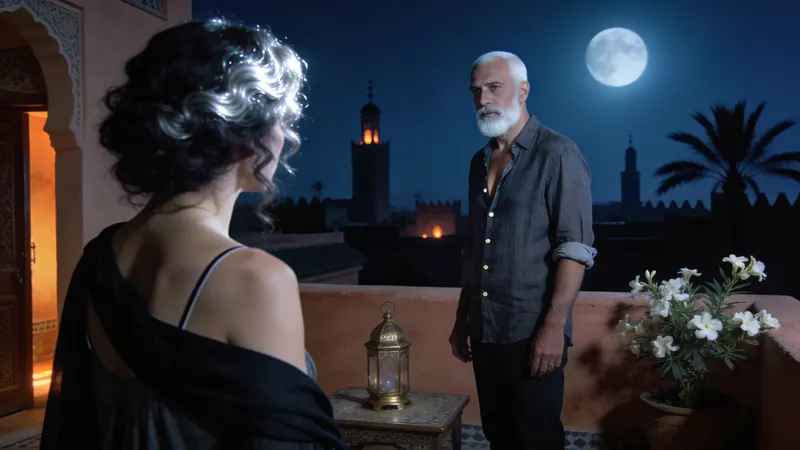
Evening takes you to the rooftop, because the walls of the medina hold the day’s heat like a held breath and up here, at least, the air moves. The Atlas Mountains are going violet at the horizon, ridge after ridge dissolving, and the swifts are stitching the sky above the tombs.
He is already there, seated at the low table with a page of manuscript weighted by a stone, signing something in the margin with a brass fountain pen bound, inexplicably, with green thread wound round and round the barrel.
You sit at the far end of the table, and he does not object. Somewhere below, the family is laying out bread and dates, and the murmur of it rises through the stairwell like the fountain’s sound, ordinary, ongoing.
When you reach into your bag for your notebook, the tin of dried jasmine slides out, hits the tile, and rolls. It rolls the whole length of the rooftop with a small metallic note, the lid you have thumbed smooth over years of workrooms catching the last of the light, and it stops against his shoe.
He bends and picks it up. Then, instead of handing it back, he works the lid loose and breathes it in, eyes closing, with the concentration of a man reading a difficult text.
“Jasminum grandiflorum,” he murmurs. “The one that means longing.”
“That was your reading of it,” you say. “I only wrote it down.”
He holds the tin out to you across the table. Your fingers close around the warm metal, and his do not let go at once, and the look he gives you lasts one full second longer than condolence allows. Twenty years collapse again, but differently this time, into a space the width of a table.
“There is something I have meant to give you,” he says quietly, “for twenty years.”
Then the call to prayer rises from the minaret of the Kasbah, immense and immediate, and swallows whatever comes next.
Chapter 2: What the Margins Kept
The prayer ends, and the night does not give the sentence back. You lie awake in your room off the courtyard, listening to the fountain count its small coins of water, and you do not sleep so much as wait for morning to arrive and explain what he meant.
Morning comes with mint tea on a tray and Karim standing at the courtyard door of his room, holding it open for you without a word.
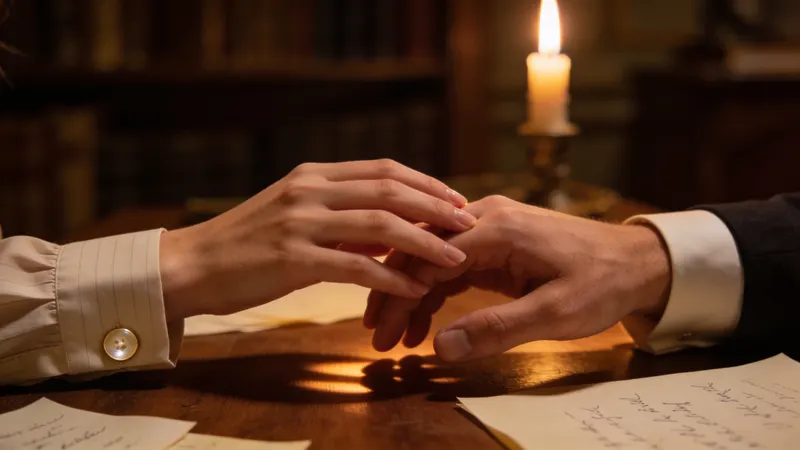
The room is spare: a bed, a desk, a lamp, stacks of paper weighted with stones. He takes down a cloth folder from the shelf above the desk, the kind of folder a man keeps when the contents matter more than the container, and lays it on the desk between you.
“Twenty years,” he says. “You should sit.”
You sit because your knees decide before you do. He opens the folder, and the first page inside is your handwriting, twenty years younger, blue ink, the essay you wrote on the language of plants in Andalusian poetry. The margins are dense with a looping script you recognized yesterday in a condolence book, and they are not corrections: you read them one after another and find them dated, all of them, a whole seminar’s worth of dates.
She sees what the poets hid. Beside your paragraph on jasmine, in his hand: Only she will understand why I copy this here. And then a line of Rumi, in Arabic, about the reed cut from its bed, singing of separation.
You turn the pages and find every paper you ever submitted, every margin full, admiration dated and initialed and kept for two decades in a cloth folder like something a man is not allowed to say out loud.
“You kept these,” you say, and your voice comes out lower than you meant.
“I kept everything you wrote.” He stands at the window, not looking at you, giving you the courtesy of reading without a witness. “The lines of poetry were for you. I chose them because you were the only person in that room who would have understood them without a footnote.”
“Karim.” The name costs something; you have not said it aloud in twenty years. “You never looked at me. Not once. I sat in the back row and I was certain you didn’t know my name.”
“A professor does not look twice at a woman in his seminar.” His voice is flat, declarative, the way he delivers everything that matters. “So I looked nowhere at all. It was the only honorable direction.” He turns then, and his eyes carry the weariness and the quiet fire you remember, both aged, neither dimmed. “Every paper, I read twice. Once to grade it. Once to keep you in the room a little longer.”
Yesterday rereads itself in your hands: the greeting by your work, the remembered essay, the cold precision. It was never indifference; it was restraint, practiced for twenty years until it became a posture. You set the folder down carefully, the way you handle old manuscripts, and the question rises before you can stop it: what does restraint like that cost, and which of you has been paying.
By afternoon the cemetery has thinned to the faithful few. The cypress shade falls long and cool, and the heat that crushes the alleys cannot reach under it, so your skin registers the relief before your mind permits it. You walk between the graves beside him, slower than the path requires.
“Leila died three years ago,” he says, without preamble, the way grief loosens tongues after the second day of mourning. “A Tuesday. I was reading aloud to her. She fell asleep in the middle of a sentence and did not wake, and I finished the sentence anyway, because she would have wanted the grammar completed.”
You laugh once, helplessly, and it is the wrong response and exactly the right one, because his mouth does something almost like a smile.
“Since then I have believed that wanting anything again is a betrayal of her,” he says. “It is a clean belief. It keeps the house tidy.” He stops walking. “It has also, I find, stopped working.”
You almost tell him. The last session of the seminar, the afternoon you invented a fever because you were afraid of what you would say to him if you stayed after the others left. The confession rises all the way to your teeth, and you hold it there, because some things need a door and a lamp and not a cemetery.
His hand finds yours among the cypress shade, deliberate and unhurried, the back of his fingers against the back of yours, nothing taken, everything offered.
“Ibn Arabi says the heart has only one room,” he murmurs, “and it is furnished by whoever enters. Is there room?”
A quotation instead of a question, because that is how he asks. You turn your palm up, and his fingers settle into it, and his thumb rests once against your wrist where the pulse runs, finding it, keeping it. Nothing more happens, and somehow everything does. You stand there holding hands like two people with twenty lost years and three remaining days, and the shade moves across both of you without asking permission.
Night on the rooftop. The family has gone to bed, and the tiles still hold the day’s heat under your bare feet while the wind off the Atlas comes cool across your arms, the two temperatures arguing on your skin. He stands closer than condolence allows, and neither of you mentions it.
“Tomorrow they all leave,” he says. “The day after, the riad empties.”
“I know how memorials end.”
“Then you know I will not begin anything I cannot continue past these three days.” His voice drops, quiet and exact. “I am sixty-eight. I do not start things to abandon them.”
His thumb finds your wrist again in the dark, deliberate as it was among the cypresses, and your pulse answers it before you can decide anything. The rule of the house and the rule of mourning stand at the door behind you like chaperones neither of you invited.
“I am fifty-one,” you say, “and I am done with being careful. Careful is how you get a folder full of margins and twenty years of nothing.”
He goes still. Then he laughs, his rare laugh, the dry one that arrives a beat late, and it is close, his face is close, his mouth a breath from yours, the brass pen still in his breast pocket near enough that you can feel its small hardness when the wind presses his shirt against you.
He stops there, and he holds the almost like a man who has had twenty years of practice holding it.
“Tell me plainly,” he says, his mouth nearly on yours. “Do you want me to continue?”
And the wind comes off the mountains, and the tiles give up their heat under your feet, and you have not yet answered.
Chapter 3: The Green Thread
The question hangs in the dark between you, and you answer it the only way that feels honest, in his own language.
“‘The minute I heard my first love story, I started looking for you,’” you say, the Rumi line he wrote once in the margin of your paper, twenty years ago, in green ink. “You wrote that next to my paragraph on rosemary. I memorized it without deciding to.”
He exhales, slow, and his forehead touches yours. “That is the longest yes I have ever been given.”
“Then take it.”
The kiss is not urgent. It moves the way water moves in the courtyard fountain, patient, finding its level, and his beard is softer than you let yourself imagine all these years, and his mouth knows how to wait even now, even here, with the tiles warm under your feet and the whole sleeping house below. His hand comes to the side of your face and stops there, a question in itself.
“More?” he murmurs against your lip.
“Everything,” you say. “Slowly. We are good at slowly.”
His laugh lands a beat late, warm on your cheek, and he takes your hand and leads you down the stairwell, past the shuttered rooms of sleeping relatives, into his.
The lamp is low. Through the wooden shutter the fountain keeps up its small conversation with the night, and the sheets are cool when he draws you down onto them, cool against the day’s heat still stored in your skin.
He undoes the pins from your hair one at a time, setting them in a row on the bedside table like a man annotating a text, and the silver threads come loose over your shoulders.
“Do not say anything kind about my hair,” you warn him. “I will only deflect it.”
“Then I will say it in Arabic, where you cannot deflect what you must translate.” His fingers move through the curls, unhurried. “There. Now you have to sit with it.”
His mouth finds your collarbone, and his beard leaves a faint burn there that you will look at tomorrow in the mirror and keep. There is no performance in any of it. His hands know their own age and treat yours the same way, as texture, as history, as something to read rather than excuse. When his palm slides over your hip you catch his wrist, and he goes still at once, attentive.
“Not no,” you say. “I want to tell you something first, because if I don’t say it now I will rewrite it for another twenty years.”
He waits, because waiting is his whole art.
“The last session of your seminar,” you say. “The one I missed. I didn’t miss it. I stood outside the door for ten minutes with my paper in my hand, because I knew that if I sat down across from you I would say something I couldn’t take back. So I took back my whole afternoon instead.”
For a moment he only looks at you. Then the laugh comes, low and disbelieving, his forehead dropping to your shoulder.
“I waited by that door,” he says. “I told myself I was returning a book. I stood there like a fool with a book I had already read twice.”
“Twenty years,” you say, “and we were both on the wrong side of the same door.”
“Then let us not be careful about this one.” His mouth returns to yours, and his quiet questions continue, a murmur against your throat, a pause at each new threshold, and your answers come uncarefully, come plain, until there is nothing left to translate.
After, you lie tangled in the sheets with the fountain whispering through the shutter, his hand resting open on your stomach as if holding a page down in wind. On the bedside table, without either of you commenting on it, your jasmine tin sits beside his brass pen, the green thread catching the lamplight.
“Desire did not expire,” you say into the dark, testing the sentence out loud for the first time in your life.
“No,” he says. “It waited. It is a patient thing. Like jasmine. It only needs one warm night.”
The third day arrives in full sun, and the courtyard is a furnace of farewells, luggage in the doorway, relatives embracing in the heat with their foreheads damp. You stand at the edge of it in your mourning dress, your wrist still warm where his thumb has not touched it in hours, and everything between you must now survive daylight.
Karim steps into the center of the courtyard with his cloth folder under his arm, the abandoned Sufi translation, twice abandoned, and sets it closed on the table beside the condolence book. The family quiets the way families do when an old man chooses a moment.
“My wife is remembered,” he says. “She would not want her memory to be the place where I stopped living.” He looks at you across the courtyard, openly, in front of everyone, and the look lasts as long as it needs to. “I will finish the translation. And I will not do it alone.”
Nobody misunderstands. The eldest aunt looks from him to you and smiles into her scarf.
Then he takes the brass pen from his breast pocket and works the green thread loose with his careful fingers, the thread that has held it together longer than some marriages. He crosses the courtyard and ties it, loosely, around your wrist, and his fingers stay a moment on your pulse.
“Keep it,” he says. “It was always holding something together. Now it can hold something open.”
That evening, when the last taxi has taken the last cousin and the riad exhales into emptiness, you climb to the rooftop together. The Atlas is going violet. On the table the translation lies open between two chairs, your jasmine tin beside his pen, and he sits down across from you and turns the page for both of you.
The end
Editorial collection: The Half-Light Collection
Related stories