The Price of Touching the Sky
Synopsis
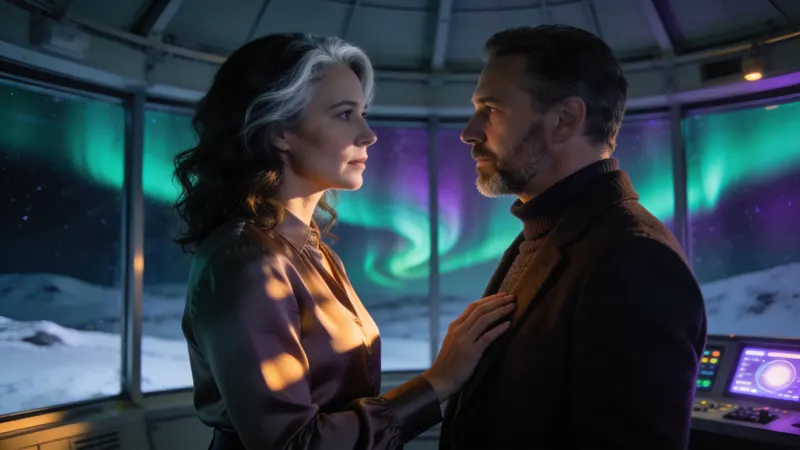
At a frozen Arctic outpost, Elena Marlowe, 42, and Rajan Voss, 45, both astrophysicists, find their growing desire awakens a cosmic force. When their bond triggers unexplained auroral surges, they must choose between duty and a love that could open gateways to the universe. With explicit, consensual intimacy, this paranormal romance blends midlife vulnerability, scientific tension, and celestial wonder.
What to expect
- Isolated Arctic setting beneath the northern lights
- Brilliant rivals turned lovers with simmering tension
- Explicit, consensual intimacy rooted in trust
- A cosmic phenomenon tied to emotional connection
- A hard-won, emotionally resonant ending
Tropes: Slow burn, Strangers, Workplace romance, Second chance
Story details
| Chapters | 3 |
|---|---|
| Reading time | 17 min |
| Spice level | 4/5 |
| Rating | – |
| Reads | 0 |
| Status | Complete |
| Published | |
| Updated |
Chapter 1: The Wrong Variables
Elena Marlowe recalibrated the primary sensor for the third time, because the impossible energy spike on her screen had arrived three days early.
At forty-two, she had spent fifteen years preparing to measure the alignment of solar winds, magnetic fields and a dormant pulsar that astronomers had nicknamed the Sleeping Serpent. She had written the proposals, survived the review panels, fought for this posting at the edge of the frozen tundra where the nearest town was a four-hour flight, and now the event scheduled for Thursday was lighting up her instruments on a Monday, indifferent to every timeline she had defended.
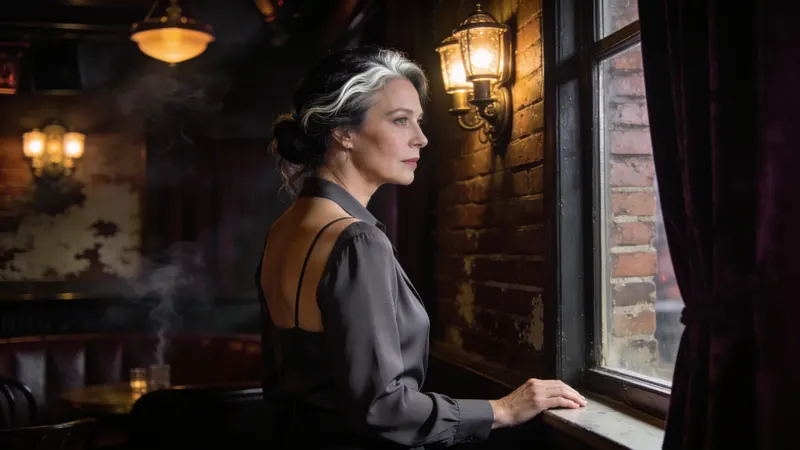
She leaned closer to the monitor, silver threaded hair falling forward, and ran the diagnostic again. The result came back identical: a surge in magnetic helicity rising in slow concentric waves, exactly the shape her resonance theory predicted, three days before anything should exist to predict.
“You’re early,” she told the screen, as if the universe might be embarrassed into behaving.
The outer door clanged somewhere down the corridor, and with it came a gust of air so cold it reached her bones even through two sealed vestibules. Elena saved her logs before she stood, because the ice-delayed flight from Resolute had apparently landed after all.
Rajan Voss filled the observatory’s narrow entryway the way weather fills a sky. He was forty-five, tall, warm brown skin windburned at the cheeks, a neatly trimmed beard flecked with melting ice, and he shed his parka in one efficient motion before looking first not at her but at the clock above the console.
“Your clock is seven seconds fast,” he said, and smiled. “I prefer to think I’m on time.”
“I prefer accurate clocks.”
“Then we’ll get along beautifully. You fix the clocks, I’ll keep arriving.” He set his satchel on the bench, and a worn leather journal slid partway out, its cover tooled with entwined constellations and serpentine symbols that looked nothing like any star chart she knew. He tucked it back without comment.
Elena had read his papers; everyone in the field had. Voss built magnetohydrodynamic models and then, scandalously, cross-referenced them against centuries of oral observations from desert and ocean cultures, treating old sky stories as data. Half the community called him brilliant, and the other half called him poetic and meant it as a wound.
“Your last paper was poetic,” she said, shaking his offered hand. His grip was warm, and the observatory was never warm.
“Thank you.”
“It wasn’t entirely a compliment.”
“I know.” His dark eyes held hers a beat longer than professional courtesy required. “But consider this, Dr. Marlowe. The people who watched the sky for ten thousand years had no instruments. Maybe they measured the things your instruments discard.”
“Such as?”
“Feelings. The sky’s and their own.”
“We’re here to observe,” Elena said, withdrawing her hand. “Not to feel.”
“Then the sky is in for a lonely week.”
Annoyance would have been the professional response. What she did instead was catalog him the way she cataloged anomalies: the calm patience in his voice, the attentiveness when she walked him through the array, the faint trace of sandalwood beneath the cold metal air of the station. She filed all of it under irrelevant and showed him to his quarters.
The simulation surged after midnight. Elena was alone at the primary console when the helicity readings spiked hard enough to trip the safety threshold, and she reached for the manual override at the same moment another hand reached from beside her: Rajan, awake, drawn by the same alarm. Their hands brushed over the switch.
The jolt that passed through her was painless and total, an electric bloom from fingertip to shoulder. Outside the dome, the aurora erupted outward in concentric green waves, pulsing like something breathing.
They both pulled back and stared.
“That,” Rajan said quietly, “was not static discharge.”
“It was a grounding fault in the console.”
“Elena.” He said her first name as if they had agreed on it, which they had not. “The aurora answered.”
“The aurora answers solar wind. Not my hand.”
He didn’t argue; he only watched the light fade with an expression she couldn’t read, and she hated that she wanted to.
In her quarters, she rolled up her sleeve under the lamp and went still. Beneath the skin of her forearm, a silvery glow traced slow patterns, faint as breath on glass. When she pressed two fingers to her wrist, a low hum rose, not in her ears but in her chest, and it matched her heartbeat. When her heartbeat quickened, the hum quickened with it.
She slept eventually, and dreamed of stars speaking in pulses, a language of light she almost understood. She woke before dawn with an ache of wanting she could not file under anything, and found Rajan already in the spectral lab, sleeves rolled, his journal open beside the console.
“It reached you too,” he said, and it was not a question.
“I felt an electrical anomaly.”
“Call it what it was. A connection.” He turned to face her. “I know the difference, Elena. I’ve spent my career being told the difference doesn’t matter. It does.”
“Then we test it.” Her voice came out harder than she intended. “We don’t intuit. We measure. Separately. No contamination between datasets.”
“Agreed,” he said, and something in his face suggested he knew exactly how long that agreement would last.
The agreement lasted thirty hours, and the problem was the observatory itself: two scientists, one kitchen, one corridor, three days of deep winter dark pressing against every window. Shared meals became conversations, and conversations became the discovery that his laugh was low and unhurried and did something treacherous to her concentration. She passed him in the corridor and caught sandalwood; he refilled her coffee before she asked and remembered she took it black.
During the evening diagnostics on the second night, their shoulders brushed at the console, and neither of them moved away. The contact was warm through two layers of clothing, steady, deliberate in its stillness, and Elena stood there cataloging her own pulse like a traitor to her own protocols.
“This is a confounder,” she said.
“Yes,” Rajan said. “It is.”
“We should run the simulation together. Controlled conditions. If proximity correlates with the spikes, we need to know.”
“We should,” he agreed, and the corner of his mouth lifted. “For science.”
“For science.”
They stood side by side at the primary console, the dome open above them, the aurora already gathering like an audience. Elena laid her fingers above the controls, and his hand hovered beside hers, close enough that its heat reached her skin.
“Ready?” he asked.
“Ready.”
Their fingertips grazed.
The aurora flooded the dome with emerald light so dense it turned his face green and gold, and the hum in her chest surged into a chord. Then a voice bloomed inside her mind, resonant, vast, neither male nor female, arriving the way her dream had arrived, as if it had always been speaking and she had only just learned to hear.
“The bond begins.”
Elena gasped and jerked her hand back. Every instrument on the console registered nothing: no source, no frequency, no electromagnetic signature, nothing except her own hammering heart and Rajan’s face, which held the precise shape of her shock, his lips slightly parted, his eyes moving as if listening to an echo.
“You heard it,” she whispered.
“Three words,” he said, his voice unsteady for the first time since he’d walked through her door. “The bond begins.”
On the dark monitor in front of them, the screen caught their reflections, two figures bathed in dying green light. And in that black glass, their reflected mouths moved once more, in perfect unison, repeating the words they had only heard.
Elena watched her own reflection speak, and understood that whatever had happened, it had happened to both of them.
Chapter 2: Controlled Conditions
Elena did not sleep. She sat at her desk until three in the morning with both audio logs open, hers and Rajan’s, and she did what she had done her whole career when the universe misbehaved: she measured it.
“Same words,” she said when he knocked on her door with coffee. She had called him at dawn and he had come without hesitation, beard damp from the shower, sandalwood cutting through the stale air of her quarters. “Same tone, same timing, to the millisecond. Neither of us imagined it.”
“No,” Rajan agreed, setting a tablet beside her laptop with his own data already overlaid. “And look at this. Every electromagnetic spike in the past two days lines up with a moment of contact. The override panel. The corridor. Last night.”
She stared at the correlation plot, at that perfect, obscene alignment, and the conclusion assembled itself whether she wanted it or not. “Then we test it. Controlled conditions.”
He almost smiled. “Of course that’s your first instinct.”
“It’s my only instinct. It’s kept me employed for twenty years.”
They built the protocol together over breakfast, and Elena was ruthless about it. Biometric sensors on both of them. Stages of proximity, measured in meters. Full logging. And a clause she wrote herself, in her own precise handwriting: either participant may pause or stop at any time, without explanation.
Rajan read it twice before he looked up at her. “I’ll add one thing,” he said. “Scientific curiosity gives me no claim on your body. Anything that happens in that dome happens because you want it, not because the data wants it. Say you understand that.”
“I understand it,” she said, and her voice came out quieter than she intended.
That evening, in the domed observation chamber, they began. Two meters apart, his pulse on the monitor and hers beside it, two separate rhythms. One meter, and the hum in her chest rose like a tide. At half a meter the aurora stirred overhead, green light rippling across the glass.
“May I take your hand?” he asked.
“Yes.”
His fingers closed around hers, warm, dry, steady. On the monitor their pulses aligned within four seconds, one line swallowing the other, and the aurora answered with a pulse of its own, concentric rings expanding across the sky like ripples in black water.
“Two souls, one frequency,” the voice said, inside both of them at once.
Elena’s breath caught. Rajan’s thumb moved once across her knuckles, a question, and she let it.
“Your hair,” he murmured. “May I?”
She nodded, then remembered the protocol and said it aloud. “Yes.”
He brushed a strand back from her cheek, and she leaned into his palm before she could decide not to. His face was inches from hers, his eyes lowered to her mouth, and the dome hummed while the sky burned above them. For one long second they were as close as two people can be without touching, and then Elena stepped back, because the data was extraordinary and she was terrified of it.
“We should process this,” she said.
“We should,” he agreed, and let her go.
Processing lasted four hours. She was rereading the biometric logs for the third time when he knocked, tablet in hand, some new analysis on his lips, but she never learned what it was. She crossed her small room in three steps and kissed him.
He made a startled sound against her mouth, then set the tablet down without looking and kissed her back, both hands coming up to frame her face, careful, as if she were an instrument he was afraid of miscalibrating.
“Elena,” he said against her lips. “Tell me what you want.”
“This. You. Don’t stop.”
Above them, the dormant telescope woke on its own. The dome iris opened with a low mechanical sigh, turning toward the alignment, and neither of them looked up.
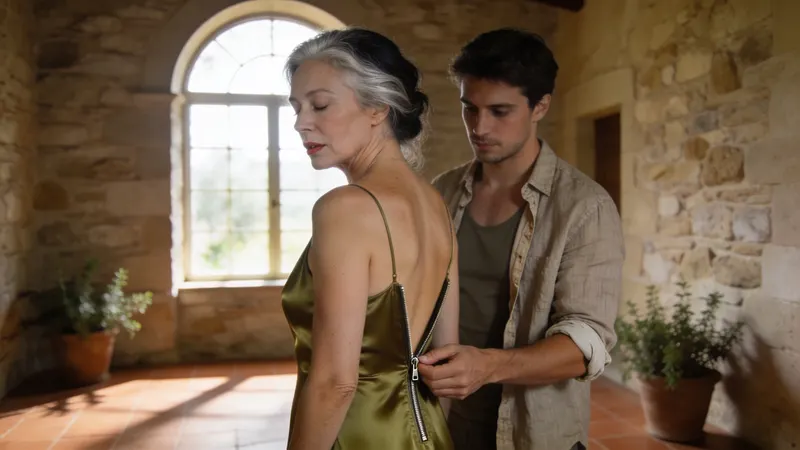
They undressed each other slowly, a button, a zipper, a pause. “Still yes?” he asked when her shirt came off. “Yes,” she said, and then, when his fingers found the clasp of her bra, she caught his wrist. He stopped instantly.
“It’s been a long time,” she said. “Since I let anyone see me like this. I need you to know that.”
He waited, his hands still, not touching her. “Then I’ll tell you what I see,” he said quietly. “Silver in your hair. A mind I have admired for years. A body I want to learn with my hands, slowly, if you’ll let me. Nothing about you disappoints me, Elena. Nothing could.”
“Continue,” she whispered, and he did.
His mouth traced her throat, her collarbone, lower, and she let her head fall back, let the hum in her chest sync with the hum in the walls. When they reached the bed she said the word first, because she needed to know it existed. “Safeword. Nova.”
“Nova,” he repeated. “Say it and everything stops. Say anything and everything slows.” He produced a condom from his bag, and she almost laughed.
“You came prepared.”
“I came hopeful,” he said, and she did laugh, and the laugh broke something loose in her that twenty years of caution had kept sealed.
“Slowly,” she told him when he settled over her. “I want to feel every second of it.”
He entered her slowly, exactly as she asked, his forehead against hers, his breath uneven, and she watched his face the whole time because she could, because he let her. When the voice came, resonant, enormous, “The union strengthens the veil,” they froze together.
“Did you,” he started.
“I heard it.” Her heart slammed against her ribs. “Do you still want this?”
“Only if you do.”
“Don’t stop,” she said. “Rajan. Don’t stop.”
He moved again, deeper, and she guided him with her hands and her voice, “there, yes, like that,” and he answered every word until the words dissolved into something older than language. Her climax came first, rolling through her in waves that made the aurora outside flare white at its edges, and his followed with her name in his mouth, and for a moment the hum in her chest and the hum in the observatory were the same sound.
Afterward she lay against his shoulder, skin cooling, his heartbeat slowing under her palm.
“I’m afraid,” she said, because the afterglow had made her honest. “Not of it. Of what it costs. If this gets out, I’m not the resonance theorist anymore. I’m the woman who slept with her colleague and called it data.”
He opened his mouth to answer. “Elena, there’s something I should”
Her laptop chimed. The sound was so ordinary that neither of them moved at first. Then she read the email over his arm, and the warmth drained out of her.
Oversight. Anomalies detected by satellite. Complete data within forty-eight hours, or suspension pending review.
“We have forty-eight hours,” Rajan said, sitting up. “Then we control the story. One test. Bounded, documented, on our terms.”
They chose the outer platform, fully clothed, parkas zipped against a wind that could strip skin, instruments recording from the dome. “Same rules,” she said. “Either of us can stop.”
“Same rules,” he agreed, and took her gloved hands, and she rose up on her toes and kissed him through the cold.
The voice arrived like a bell the size of the sky. “The gate stirs.”
Light erupted from the dome behind them, a column of pale gold punching upward through the aurora, visible, she knew with sick certainty, from every satellite in the hemisphere. Alarms began inside, one after another, a chorus of them, and the satellite phone in the comm room was ringing before they got the door open.
They stood in the doorway, unharmed, holding each other, watching the light slowly die.
By morning the lockdown order filled every screen in the observatory, red text, official seals. Elena reached for the satellite phone to call oversight first, to get ahead of it, to be the one who reported rather than the one reported. Her hand was still an inch from the receiver when Rajan caught her wrist and pointed out the window.
Through the blowing snow, low over the ice strip, a military transport dropped toward the frozen tundra, its landing lights cutting white paths through the dark.
Chapter 3: Only Unity
The transport’s rotors had barely stopped turning before two officials in gray parkas came through the observatory door, and from that moment Elena Marlowe’s world narrowed to questions asked in a conference room that smelled of burnt coffee and cold metal.
They interviewed her alone first. A woman named Okafor read from a tablet while a man named Reyes watched Elena’s hands, and Elena gave them calibration data, timestamps, the physics of the beam, everything narrowly factual, though each precise answer sat in her mouth like a stone. She was not lying, exactly. She was omitting, and the omission felt filthier than any lie she had ever told.
By the second day they had confiscated the encrypted drives, locked the primary systems behind their own credentials, and informed both scientists that suspension was the likely recommendation. When they finally left Elena and Rajan alone in her quarters, the silence between them had teeth.
“I should have stopped us,” she said. “On the platform. Before any of this.”
Rajan stood near the small window, his parka still open, and he looked at her the way he had looked at her across the controls that first night, patient and unafraid. “You can regret the timing,” he said. “But don’t rewrite what happened. Every step, you chose. I chose. We asked each other, every time. What we’re facing now is consequence, not wrongdoing.”
“I need you to go,” she said, and hated her own voice, and he nodded and went.
He came back an hour later with the worn leather journal in his hands, and he set it on her desk like something that cost him.
“I have loved you since Geneva,” he said. “Ten years. Your presentation on magnetic helicity, and afterward I asked you about resonance in pulsar winds and you answered me for twenty minutes like I was the only person in the building. I requested this posting. I wanted to know you. Everything in that journal is what I observed, about the sky and about you, and I never intended to use any of it to claim you.”
The anger came up in her so fast it almost choked her. “You let me think this was chance. You let me run statistics on our meetings like a stranger.”
“I know.” He did not flinch. “If you want me gone, I’ll request a transfer tomorrow and I will not argue. My history doesn’t oblige you to anything. Neither does whatever is speaking to us. You owe me nothing.”
She opened the journal. His handwriting filled a decade of pages, serpentine symbols beside star charts, and near the end, dated Geneva: she answered as if the question mattered more than the room.
“I remember that question,” she said quietly. “I wondered about you after. I looked for your name on papers for a year.” She closed the cover and held it against her chest. “Ten years, Rajan. We were never strangers. We were a missed connection with a very long delay.”
The voice came then, vibrating up through the floor plates, through the bed frame, through her bones. “Only unity can sustain the gate.”
They stood looking at each other, and Elena answered it as much as she answered him. “It doesn’t get to command us,” she said. “If unity means anything, it means honesty and choice. If either of us wants to walk away, the gate can close. I’d rather lose it than be conscripted by it.”
“Agreed,” Rajan said.
So Elena sat down at the unlocked terminal and did the thing she had spent her whole adult life avoiding. She transmitted everything: the unedited logs, the complete protocol with its consent stages, Rajan’s journal scanned page by page, and a signed personal statement withdrawing her calibration evasion and naming every omission she had made under questioning. Her reputation, her sole claim to the discovery, fifteen years of armor, all of it went out on that transmission, and her hands were steady.
Oversight’s answer came six hours later: one final test, instrument monitored, physical privacy protected by a shielded chamber and a sealed biometric feed. It was more than she had dared to hope.
The chamber beneath the observatory was small and warm, lined with dull copper mesh. They undressed each other slowly, and there was nothing furtive in it now, nothing hidden.
“Nova still stands,” she said.
“Nova always stands,” he murmured, and kissed the silver at her temple.
He rolled on a condom and lay back against the folded blankets, watching her. “Tell me what you want.”
“Your mouth,” she said. “Here.” She guided his head down with her hand in his hair, and he went gladly, and she told him everything, softer, slower, there, don’t stop, her voice unraveling into moans as his tongue moved over her and the last of her control dissolved into warmth. When the pleasure broke over her she said his name into the copper dim like a confession.
Only when her breathing steadied did she draw him up over her. “Now,” she whispered. “Inside me. Slowly.”
“Yes,” he breathed, nothing hurried in it, and he entered her with a care that made her eyes sting, and they moved together while the mesh above them began to glow.
“I choose you,” she said against his mouth. “Even if the gate closes. Even if we get nothing. I choose you.”
That was when the voice came, vast and settling, and above the dome a spiral of pale gold light turned once and steadied into a constant, quiet presence. Their climaxes arrived together, her name in his throat and his in hers, and afterward they lay tangled and laughing a little at the sheer impossibility of it, at the fact that honesty had done what secrecy never could.
The stable readings corroborated everything they had disclosed. Within two days the shutdown order was replaced by a supervised international inquiry, their careers uncertain but their evidence and their integrity intact, which Elena discovered felt remarkably like freedom.
A week later she sat at Rajan’s desk with his journal open and wrote their first joint entry, her angular script beside his, describing the spiral, the voice, and the choice that preceded it. She left the next page blank, because something still pulsed from the gate, slow and unanswered, and neither of them could yet say what it was asking.
On her way out she passed the console, where the clock glowed its familiar wrong time. Her hand rose out of old habit, and she let it fall.
She left the clock seven seconds fast.
The end
Editorial collection: The Moonless Collection
Related stories