Play It Again, Slower
Synopsis
A mature lesbian romance with an age gap, slow-burn tension, and explicit heat, set against the intimate backdrop of music and memory. Marisol Voss, 47, runs a Chicago jazz club in quiet tribute to her late wife. When 33-year-old cellist Noor Moretti arrives for a residency, their connection deepens through shared melodies and longing glances, challenging boundaries with tenderness and consent.
What to expect
- A sensual, music-fueled connection between two women from different worlds
- Slow-burn tension building through silence, glances, and shared artistry
- Emotionally rich intimacy with explicit, enthusiastic consent
- A forbidden romance that challenges personal boundaries and public expectations
Tropes: Strangers, Slow burn, Workplace romance, Age gap between adults
Story details
| Chapters | 3 |
|---|---|
| Reading time | 15 min |
| Spice level | 4/5 |
| Rating | – |
| Reads | 1 |
| Status | Complete |
| Published | |
| Updated |
Chapter 1: First Note
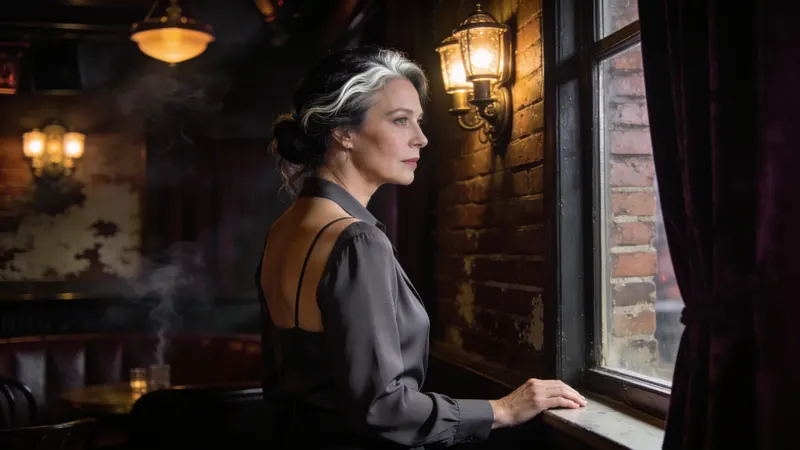
The Blue Embers hummed with the quiet energy of anticipation, its low ceiling glowed amber from vintage sconces and the soft pulse of stage lights being tested. Beneath a weathered brownstone in Chicago’s West Loop, the jazz club was a sanctuary of smoke-stained brick and velvet shadows, a place where time bent to the rhythm of improvisation. Marisol Voss stood at the edge of the stage, arms crossed, her tall frame silhouetted against the dim haze. At forty-seven, she moved with the precision of someone who had spent decades conducting silence as much as sound. Her silver-streaked dark hair was pulled into a loose knot, and her charcoal blouse clung to her like a second skin, tailored to conceal the weight of grief she carried.
She watched the sound engineer adjust levels, her expression unreadable. Two years since Mara’s passing, and the ache hadn’t dulled so much as settled, a low, constant hum beneath her ribs. The club had been Mara’s dream, Marisol’s reluctant inheritance. She kept it running not for passion, but for memory. And yet, something about tonight felt different.
The door at the back creaked open.
Noor Moretti stepped in, her cello case slung over one shoulder like a second spine. At thirty-three, she carried herself with the kind of warmth that defied the autumn chill clinging to her coat. Her curls escaped in soft spirals around her face, and her deep brown eyes scanned the room with quiet reverence. She unzipped her jacket, revealing a fitted turtleneck that hugged the curve of her collarbones. A composer, a cellist, a woman who played music like she was pulling secrets from her bones.
Marisol hadn’t seen her before tonight, though she’d read the bio: Noor Moretti, rising star of contemporary chamber-jazz fusion, known for performances that blurred the line between composition and confession. Now, here she was, tuning her instrument in the quiet dark, bow resting gently against strings as she leaned the cello between her knees.
Their eyes met.
No introduction. No smile. Just a stillness that stretched, taut and electric, across the empty club. Marisol felt it, the way the air shifted, the way her breath caught, subtle as a missed beat. Noor held her gaze for a heartbeat longer than necessary, then looked down, fingers adjusting a peg with deliberate care. But the moment lingered, suspended like a note waiting to resolve.
Marisol turned away first.
The night unfolded in waves. The ensemble took the stage, piano, double bass, drums, each musician deferring to Noor as she lifted her bow. The first piece began softly, a meditation in minor keys, but then Noor leaned into the music, her body swaying, her face a map of feeling. She didn’t just play the cello. She answered it, challenged it, surrendered to it.
And Marisol listened.
She stood near the bar, a glass of bourbon untouched in her hand, her back pressed to the cool wall. But her attention was riveted. There was something in the way Noor phrased her lines, long, aching notes that trembled on the edge of breaking, then resolved into something fierce and tender. It wasn’t just technique. It was testimony.
It felt like a conversation meant for her.
During the final piece, Noor closed her eyes, her bow gliding across the strings in a slow, weeping phrase that unraveled something deep in Marisol’s chest. For a moment, just a moment, she forgot to breathe. Forgotten memories flickered: Mara’s hands on the piano, the way she’d played that same melody the night before she died. Marisol’s fingers tightened around the glass.
The audience erupted in applause. Noor rose, flushed and radiant, accepting bows with a humility that belied her command. But when her gaze swept the room, it landed on Marisol again. And this time, she smiled.
After the set, the club emptied, leaving behind the scent of whiskey and candle wax. Marisol poured two fingers of bourbon into a fresh glass and carried it to the corner table where Noor sat, still loosening the tension in her shoulders.
“You didn’t touch your drink earlier,” Noor said, voice low and rich, like the cello’s lowest register.
“I wasn’t thirsty then,” Marisol replied, setting the glass in front of her. “Now I am.”
Noor studied her. “You used to play, didn’t you?”
Marisol stilled. “How do you know that?”
“Your hands,” Noor said simply. “They rest like a pianist’s. Like you’re always one note away from the keys.”
A beat passed. “I did. A long time ago.”
“Do you still?”
Marisol looked down at her hands, long fingers curled loosely in her lap. “No. Not in years.”
Noor didn’t press. She took a slow sip of bourbon, her eyes never leaving Marisol’s. “You know,” she said, “silence can be as loud as sound. Sometimes louder.”
Marisol exhaled, the words settling into places she hadn’t let anyone touch. “Maybe,” she said quietly. “But silence is safer.”
“Is it?” Noor leaned forward slightly. “Or is it just lonelier?”
The question hung between them, unguarded and true.
They talked then, about music, about the way certain pieces could feel like they were written for one person alone. Noor spoke of composing as an act of vulnerability, of how she wrote melodies she wasn’t ready to say out loud. Marisol listened, her defenses thinning with each passing minute. She found herself wanting to ask: What would you write for me?
But she didn’t.
Later, long after the staff had locked the doors and the city outside had quieted, Marisol stood at the window of her loft above the club. The space was spare, white walls, a single armchair, and the grand piano in the corner, untouched for two years. Its black surface reflected the city’s glow, a silent monument.
And then she saw her.
Through the glass partition that overlooked the club’s rehearsal space, Noor was there. Alone. Her cello cradled between her knees, she played a slow, improvisational line, raw and searching. Her body moved with the music, head tilted, eyes closed, every muscle alive with intent. She wasn’t performing. She was confessing.
Marisol watched, transfixed. The way Noor’s fingers danced over the fingerboard, the way her breath synced with the bow’s arc, it was intimacy without touch. And then, as if sensing her, Noor opened her eyes.
Their gazes locked through the glass.
No words. No gesture. Just a smile, small, knowing, unafraid. And she didn’t look away.
Marisol’s pulse thrummed in her throat. Something shifted inside her, a door creaking open after years of being sealed shut.
Minutes later, her phone buzzed on the table.
She picked it up.
The screen glowed.
Can I come up? I’d like to hear you play.
Chapter 2: Harmony in the Dark
Marisol stared at the text, the glow of the screen illuminating the planes of her face in the dim loft. Her fingers hovered over the keyboard, heart drumming a staccato rhythm beneath her ribs. It had been two years since anyone had asked to hear her play, two years since the last time her hands had touched these keys with anything close to feeling, since before the silence that followed loss, thick and suffocating.
She typed, deleted, typed again. Finally: Yes. Come up.
A minute later, a soft knock echoed through the quiet space. Marisol crossed the room, bare feet silent on the polished wood, and opened the door.
Noor stood there, cello case slung over one shoulder, her curls slightly tousled from the night air. She wore a deep burgundy sweater that brought out the warmth in her brown skin, and her eyes—wide, bright, unguarded—met Marisol’s with an openness that made Marisol’s breath catch.
“I brought music,” Noor said, lifting the case slightly. “Not to pressure you. Just… to share.”
Marisol stepped aside, wordless, and let her in. The air shifted with Noor’s presence, charged with something neither of them named but both felt, the magnetic pull of two souls recognizing each other in the dark.
They didn’t speak at first. Noor set her case down by the armchair and unzipped it with careful hands, lifting out the cello as if it were something sacred. Marisol watched, arms crossed loosely over her chest, the familiar weight of hesitation pressing against her lungs.
“You don’t have to play if you’re not ready,” Noor said softly, settling the instrument between her knees. “But I’d love to hear even one note.”
Marisol looked at the piano. The bench, black leather worn smooth from years of use, faced her like an old friend she’d betrayed. She exhaled slowly, then walked over and sat down.
Her hands hovered above the keys. Dust motes danced in the low light, catching on the silver strands at her temples. Then, with a breath that felt like surrender, she pressed down.
A single phrase—simple, tentative—floated into the room. A fragment of something old, something half-remembered.
Noor closed her eyes. And when the last note faded, she answered with one long, resonant tone on the cello, low and warm, like a hand reaching through the dark.
Marisol turned, startled by how perfectly Noor had matched her mood, her tempo, the very shape of her silence.
They began again.
No sheet music. No plan. Just instinct.
Marisol played a question, Noor answered with certainty. A minor chord, a rising line, and Noor followed, her bow gliding with precision and passion, her body swaying into the music as if it were breath. They built something new between them—improvised, alive, a conversation in sound. The space around them seemed to hum, the city far below forgotten, the night folding in close.
And then, slowly, the music softened. Marisol’s hands stilled on the keys. Noor lowered her bow, the final note lingering in the air like a held breath.
The silence that followed was not empty. It was full of possibility, of tension, of something deeper than either of them had words for.
Noor set the cello aside and turned to face Marisol on the bench. Close now. Close enough that Marisol could see the flecks of gold in her dark eyes, the faint rise of color in her cheeks.
“Can I kiss you?” Noor asked, voice low, steady, but with a tremor of vulnerability beneath it. “Only if you want to. Only if you’re sure.”
Marisol’s pulse thundered in her ears. She had spent two years building walls, guarding against this very moment, against the risk of feeling, of needing, of losing again. But Noor wasn’t asking for everything. She was asking for consent. For permission. And in that, she offered safety.
Marisol looked at her, really looked, and saw no expectation, only invitation.
“Yes,” she whispered. “Please.”
The kiss began soft, a brush of lips that sent a shiver through Marisol’s entire body. Then deeper, slower, as if they had all the time in the world. Noor’s hand cupped her jaw, thumb tracing the curve of her cheekbone, and Marisol leaned into the touch like she’d been waiting a lifetime to be found.
When they parted, breathless, Noor smiled, a small, radiant thing.
“Tell me,” she murmured, “if you want me to stop. At any moment.”
Marisol nodded, her voice barely audible. “I will. But I don’t want you to stop.”
Noor kissed her again, and this time, her hands moved—slow, reverent—to the buttons of Marisol’s blouse. Each one undone felt like a vow. Marisol’s fingers trembled as they reached for Noor’s sweater, pulling it over her head, revealing smooth skin, the curve of her shoulders, the delicate line of her collarbone.
They undressed with care, with intention, as if every inch revealed was a gift. No rush. No performance. Just two women, awake and present, learning each other by touch.
Marisol traced the slope of Noor’s back, the dip of her spine, the way her breath hitched when Marisol’s fingers brushed the small of her waist. Noor moaned softly as Marisol’s lips found the hollow of her throat, then lower, across the swell of her breast.
“Tell me what you feel,” Noor whispered, her hands threading into Marisol’s hair.
“Alive,” Marisol breathed. “I feel… like I’m remembering how to breathe.”
Noor guided her down to the bed, sheets cool at first, then warming quickly beneath them. Their bodies aligned, skin to skin, heart to heart. Noor’s hand slipped between them, gentle, asking.
Marisol arched into her touch, gasping. “Yes. Oh, yes. I want this. I want you.”
Their lovemaking was tender, deliberate, a rediscovery. Marisol, so long guarded, let herself be known. Noor, fearless in her honesty, moved with reverence, her touch both confident and careful, attuned to every shift in Marisol’s breath, every tremor of her body.
When pleasure crested, it did so in waves, slow, deep, shared. They clung to each other, murmuring praise, encouragement, fragments of truth between gasps.
Afterward, they lay tangled in the sheets, limbs entwined, foreheads touching.
“I haven’t touched a piano in two years,” Marisol admitted, voice raw. “I thought I’d lost the music. But tonight… you made it come back.”
Noor kissed her temple. “You never lost it. You just needed someone to listen.”
They talked then, about music, about grief, about the quiet courage it took to begin again. About how love didn’t erase loss, but could grow alongside it, like ivy on stone.
At dawn, when the city began to stir, Marisol drifted into sleep, exhausted and sated and, for the first time in years, unafraid.
She woke to soft light and the scratch of pencil on paper.
Noor sat at the small desk by the window, wrapped in a sheet, her curls wild around her face. She was sketching notes onto a page, humming under her breath.
Marisol watched her, silent, heart full.
On the top of the sheet, written in bold script, were two words: Marisol’s Theme.
Chapter 3: Final Movement
The Blue Embers thrummed with a restless energy, the air thick with the scent of old wood, spilled whiskey, and anticipation. It was the final night of Noor’s residency, and the underground club was packed, patrons leaning into candlelit tables, jazz swirling through the low-lit space like smoke. Marisol stood in the shadows near the sound booth, arms crossed, pulse fluttering just beneath the surface of her composure. At forty-seven, she was used to control, to quiet authority, to the careful distance she’d maintained since her wife’s passing two years ago. But tonight, that distance felt paper-thin.
On stage, Noor moved with the cello like they were one being, her warm brown skin glowing in the amber light, curls escaping their loose knot, eyes closed as she poured herself into the music. She played with a fearless honesty that had first unsettled Marisol, then awakened her. Now, it unraveled her completely.
Marisol had watched every set. Every rehearsal. Every midnight moment when Noor played alone, unaware of the woman silently observing from the loft above. But tonight was different. This wasn’t just performance. It was declaration.
When the final note faded, the room erupted. People rose, clapping, shouting, whistling. Noor smiled, radiant, and took a bow. But her gaze found Marisol’s immediately, steady, searching. Not triumphant. Vulnerable.
Backstage, the corridor was narrow, lined with peeling gold paint and flickering bulbs. Noor found Marisol there, still wrapped in her quiet, her hands tucked into the pockets of her tailored coat.
“You stayed,” Noor said softly.
Marisol exhaled. “I wasn’t sure I should.”
Noor stepped closer, close enough that Marisol could smell the faint trace of vanilla on her skin, feel the warmth radiating from her. “Because of what happened the other night?”
Marisol met her eyes. “Because of everything. Because of how much it means. Because I’m forty-seven and you’re thirty-three, and this city watches. Because I’ve already lost one love, and the thought of losing another, of being seen, of being known, terrifies me.”
Noor didn’t flinch. She reached out, slow, giving Marisol time to pull away. When she didn’t, Noor took her hand, laced their fingers together. “I’m not asking you to have it all figured out. I’m not asking for promises written in stone. I’m just asking… can this continue? Can we?”
Marisol’s breath caught. “I want to. God, I do. But—”
“No buts,” Noor whispered. “Just tell me you feel it too.”
Marisol looked down at their joined hands, then back up. “I do. I feel it every time you play. It’s like you’re speaking a language I forgot I knew.”
Noor smiled, soft and sure. “Then let’s keep speaking it.”
They took the elevator up to the loft in silence, the space above the club that Marisol had converted into a quiet sanctuary, bookshelves, a worn sofa, and a grand piano that had sat untouched for years. Now, it gleamed under the soft light, like it had been waiting.
Noor set her cello case down and turned. “Do you want me to stay?”
Marisol stepped forward, heart pounding, but this time not from fear. From need. “Yes. And this time… I want to ask for what I want.”
Noor’s breath hitched. “Tell me.”
Marisol closed the distance between them. “Touch me like you did last night. I need to feel you. I need to know this is real.”
Noor’s eyes darkened with desire, but her voice remained gentle. “Only if you’re sure. Only if you tell me what you need.”
“I’m sure,” Marisol whispered. “I want your hands on me. I want your mouth. I want to feel you inside me, slow, deep, like last time. I want to come apart knowing I’m not alone.”
Noor exhaled, reverent. “Yes. Yes, Marisol. Tell me if it’s too much. Tell me if you want me to stop.”
“I won’t,” Marisol said, pulling her close. “I want all of it. I want you.”
Clothes fell away in quiet urgency, silk sliding to the floor, fingers tracing ribs, the curve of hips, the softness of inner thighs. Noor lowered Marisol onto the sofa, her touch both confident and tender, mapping her body like a musician learning a new score.
“God, you’re beautiful,” Noor murmured, pressing a kiss to the hollow of Marisol’s throat. “Every inch of you.”
Marisol arched into her, hands gripping Noor’s shoulders. “Don’t stop. Please, don’t stop.”
Noor obeyed, her mouth trailing down, lingering at the swell of Marisol’s breast before taking her nipple into her mouth, slow and deliberate. Marisol gasped, fingers threading through Noor’s curls. “Yes, just like that. Noor.”
They moved together, learning, giving, taking. Noor’s fingers slipped between Marisol’s folds, finding her wet and ready. “You’re so open for me,” she whispered, kissing her deeply as she slid two fingers inside.
Marisol moaned into the kiss, hips lifting. “More. I need more.”
Noor obeyed, adding a third finger, curling them just right, her thumb circling Marisol’s clit in slow, steady strokes. Marisol clutched her, whispering praise, encouragement—“Yes, just there, don’t stop, I’m close”—until pleasure crested, bright and shattering, and she came with a cry muffled against Noor’s shoulder.
After, they shifted to the bed, tangled in sheets, limbs entwined. They laughed, low and intimate, whispered secrets between kisses. Noor traced patterns on Marisol’s skin, her voice soft. “I’ve never met anyone who holds silence like you do. Like it’s sacred.”
Marisol turned to face her. “You taught me it doesn’t have to be lonely.”
Morning came slow and golden. Noor packed her cello carefully, her movements quiet but unhurried. At the door, she turned, duffel bag in one hand, case in the other.
Marisol stepped forward, heart in her throat. She reached into her pocket and pulled out a key, the one to the loft. “Here.”
Noor looked at it, then at her. “What’s this?”
“A key,” Marisol said. “To the loft. To me. Come back. Play for me again.”
Noor’s eyes shimmered. She took the key, then stepped forward, cupping Marisol’s face. “I will. Every chance I get.”
She kissed her, slow, deep, sure. A promise sealed in breath and touch.
Marisol watched from the window as Noor disappeared into the Chicago morning, the key still warm in her hand. Below, the city hummed, alive with rhythm and motion.
She walked to the piano, sat, and placed her fingers on the keys. Hesitated.
Then she played.
Marisol’s Theme rose into the light, melancholy, yes, but no longer afraid. The silence between the notes wasn’t empty. It was full of possibility. Full of music. Full of love, waiting to be answered.
The end
Editorial collection: The Mirror Collection
Related stories