The Warmth Three Hands Kept
Synopsis
You're a 62-year-old retired forestry ecologist in Asheville, living quietly since your wife passed. Mae, your oldest friend and a ceramic artist, and Ellis, a 65-year-old retired jazz pianist, reenter your life around a fire pit. What begins as warmth against the autumn chill becomes a consensual threesome with friends, transforming unspoken longing into intimacy, healing, and a new kind of love.
What to expect
- Second-person immersion: you are the widower
- Slow-burn tension across three chapters
- A mature, fully consensual ménage
- A reveal that reframes thirty years of friendship
- Autumn firelight, pottery clay, and jazz
Tropes: Slow burn, Friends to lovers, Age gap between adults
Content notes: grief over a deceased spouse (non-erotic)
Story details
| Chapters | 3 |
|---|---|
| Reading time | 17 min |
| Spice level | 4/5 |
| Rating | – |
| Reads | 0 |
| Status | Complete |
| Published | |
| Updated |
Chapter 1: What the Fire Keeps
You are stacking split oak by the fire pit when Mae’s hand settles over yours on the wood and simply stays there, and you cannot remember the last time anyone touched you on purpose.
The oak is cold from the shed, bark rough against your palm, and her hand is warm. Clay lives under her nails the way it has for thirty years, a pale crescent at each fingertip, and her thumb rests across your knuckles without moving. Two years of casseroles left on porches, of men clapping your shoulder once and stepping back, and nobody has done this. Nobody has stayed.
“You’re going to let the weather take half of that,” Mae says, but she doesn’t let go. She is looking at the rick, not at you, and her voice is doing the ordinary work of a Friday while her hand does something else entirely.
You are sixty-two years old. You turned it in March, alone at this same pit, drinking a beer you didn’t finish. Since then your body has been a tool, something that splits wood and hauls brush and sleeps badly. Now the skin under her hand is awake in a way that startles you, blood rising to meet her warmth like it has been waiting for permission.
“Ellis brought the good bottle,” she says, and finally lifts her hand, slow, like a bird leaving a branch it liked.
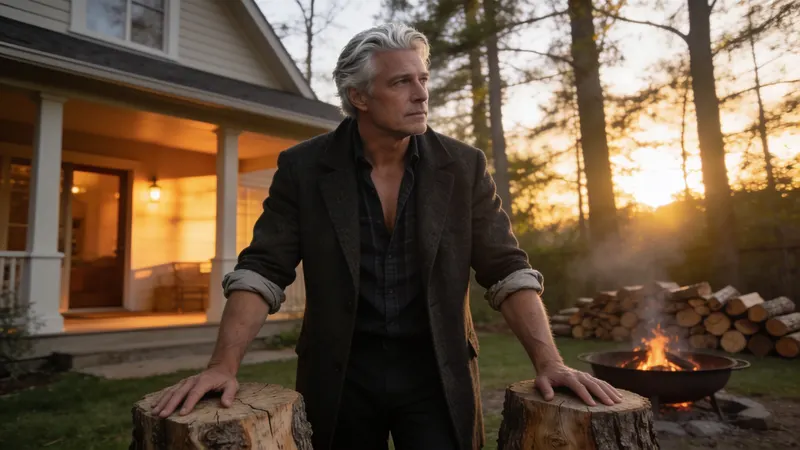
Behind you, the cabin door bangs. Ellis comes down the porch steps with the wine in one fist and three glasses pinched in the fingers of his other hand, sixty-five years old and still moving like a man about to sit down at a piano. Silver at his temples, a grin that used to close down bars in this town.
“Get the fire going before I freeze,” he calls. “My hands are too valuable for this climate.”
“Your hands are insured by nobody,” Mae says, and he laughs, and the laugh does what it always does, fills the clearing, pushes the dark back a few feet.
You build the fire the way you have built a thousand, cedar kindling first, the split oak leaning over it, and the first flame takes with that dry crackle you have loved since you were a young forester with all his tendons. The three of you settle into the old chairs. This is the ritual, every Friday since before Ruth got sick, and through the worst of it, and after. They never once asked if you wanted company. They just came.
The wine is good, dark and warm going down. Mae tells a story about a kiln disaster, a whole shelf of bowls slumped into one another, and her hands shape the catastrophe in the air. Ellis heckles. You say less than either of them, the way it has always been, and the fire paints all three of you in moving amber.
Then Ellis gets up, restless the way he gets, and wanders to the porch. The old upright sits there under its canvas, the one he refuses to let you give away, and he flips the cover back and plays through the open door, something slow, a tune with space between the notes. You know it. Ruth used to hum it washing dishes.
Mae moves her chair closer. Closer than usual. Her shoulder comes to rest against your arm, and she doesn’t apologize for it, and the warmth of her through your flannel is steady as a held breath.
Your body answers before you can stop it. A loosening low in your chest, a pull toward her so simple and physical it frightens you. And right behind it, fast as a reflex, the shame. Two years. Ruth’s ring on your hand. What kind of man sits by a fire and wants, when wanting ended at a hospital in August.
You hold very still, the way you would with a deer in the tree line.
The music stops. Ellis is standing in the doorway with his glass, watching the two of you, and there is nothing performative in his face at all. In thirty years of Friday nights, you have almost never seen him this quiet.
“Can I say something true?” he says. It isn’t really a question. “The three of us have been circling something for thirty years. We all know it. We’ve been polite about it, and we’re all too old to keep being polite.”
The fire pops. A coal settles. You say nothing, because nothing in you has words yet.
“I want you,” Ellis says, plain as a key change. “I want Mae. She wants us both, and if she wants to deny it, she can do her own talking.” His voice stays level, but his hand tightens on the glass, and the steadiness is costing him, you can see it in the white of his knuckles. “I’m not proposing anything tonight except honesty. Nothing happens without your word. Nothing ever happens without your word. But I am done pretending this circle is just about keeping you company since Ruth.”
Your throat closes around her name. You try to say it, Ruth, as a shield or an answer, and it won’t come out. Two years and her name is still a stone you swallow.
Mae’s hand finds yours in the dark between the chairs. Her fingers work their way between your fingers, clay-dry and sure.
“There’s no clock on this,” she says softly. “You hear me? No clock, no debt, no wrong answer. We just wanted it said out loud while we’re all still here to say it.”
You look at Ellis. He nods once, and the smile he gives you has nothing to sell in it, which is how you know it’s the real one.
They stay another hour and nobody mentions it again. Ellis plays one more tune, Mae leans into your shoulder like it’s her right, and the fire burns down to a red breathing bed. When they finally gather their coats, Mae stops at the edge of the firelight, lifts your hand, and presses her mouth to your knuckles. Her lips are warm. The kiss lasts one heartbeat longer than friendship has ever allowed.
“Next Friday,” she says, and then they are gone down the drive, Ellis’s old wagon rattling gravel, taillights swallowed by the rhododendron.
You stand at the pit until the coals stop answering the wind.
Inside, the cabin is too quiet, so you do the thing you do every night. You go to the dresser, work the wedding ring off your finger, and drop it into the little glazed bowl Mae made back when her hands were still learning, the one with the uneven rim and the blue that pools darker in the middle. Two years of this. The ring has clicked against that clay more than seven hundred times.
Tonight it clicks, and you stand there holding the empty bowl, and the ritual doesn’t close over you the way it always has. Tonight it opens. The ring sits in the blue glaze catching the lamplight, and the whole gesture feels like a question you have been asking without knowing it: is this keeping her, or is this keeping still.
You carry the bowl to the bed. You shouldn’t, it belongs on the dresser, that’s where it lives, but your hands don’t put it down.
You lie on your back in the dark with the bowl on your chest, rising and falling with your breath, Mae’s thumb warm on your knuckles hours after the fact, Ellis’s voice turning over and over in the black behind your eyes.
Thirty years of circling. Maybe it is time to stop circling.
The fire outside ticks as it dies, and you hold the bowl, and you do not sleep.
Chapter 2: Thirty Years of Stepping Back
You carry the bowl back to the dresser in the morning light, and it goes back where it lives, and that is the closest you come to answering anything. A week goes by like that. You split wood you don’t need, walk the ridge until your knees complain, and every evening you catch yourself listening for the rattle of Ellis’s wagon that isn’t coming, because it isn’t Friday yet, and because you never called.
On Thursday, Mae finds you anyway.
You hear her on the trail behind the cabin before you see her, the unhurried crunch of her boots on fallen leaves, and she doesn’t call out or ask what you’re doing out here. She just falls in beside you and walks. Her jacket smells like kiln smoke and woodsmoke. For a half mile she says nothing, matching her stride to yours, and the silence has her fingerprints all over it, patient, warm, waiting for you to be ready.
“You’re avoiding the studio,” she says finally, not accusing, just naming it.
“I’m avoiding saying something stupid.”
“You’ve said stupid things for thirty years. It’s part of the landscape.”
The laugh comes out of you before you can stop it, and something in your chest loosens a quarter turn. You stop at the overlook where the trail breaks open onto the valley, the Blue Ridge going soft and blue-gray into distance, and the words you’ve been carrying all week come out rough.
“She’s been gone two years. If I want you, if I want Ellis, what does that make everything I had with her?”
Mae turns to face you. There’s clay under her nails. There is always clay under her nails.
“She knew,” Mae says. “Before any of us said anything out loud, she knew what lived in this friendship. She used to tease me about it. Said I had the biggest heart of anyone she’d met and the worst poker face.” Her voice stays steady, but her eyes shine. “Grief isn’t a vow of solitude, honey. She would have told you that herself, with considerably worse language.”
You look at her for a long moment while the wind moves through the bare hardwoods. “Come to the studio tonight,” she says. “Ellis is cooking. There are things we should all say sitting down.”
The studio at dusk is lamplit and warm, the wheels still, shelves of greenware along the walls, the woodstove ticking in the corner. Ellis pours three fingers of bourbon into mismatched cups, and he doesn’t joke while he does it, which is how you know something is coming. Ellis always jokes. For forty years you have watched him charm his way through rooms, through funerals, through everything, and tonight his hands are not steady.
“I need to tell you something,” he says, “and Mae’s already heard it, so if I fumble it she’ll correct me.” He sits across from you and turns the cup in his fingers. “Fifteen years ago. The winter you two went out to Oregon for her mother’s care, do you remember? Mae and I kept the fire going here. Literally. Your pipes nearly froze.” A ghost of the old smile crosses his face. “We spent a lot of nights in this room. And one night we nearly, we came very close to becoming something more than what we were.”
The bourbon stops halfway to your mouth.
“We didn’t,” Mae says quietly from the doorway, drying her hands on a rag. “We wanted to. We stood right there by the kiln and we wanted to, and we stepped back. Both of us. Out of loyalty to you. To your marriage. To what the three of us were.”
“Fifteen years,” you say, and your voice sounds like it belongs to someone else.
“Fifteen years of stepping back,” Ellis says. “And before that, another fifteen of pretending not to notice. That’s what I meant at the fire pit. It was never new. We just finally ran out of ways to lie about it.”
The cold water of it goes through you all at once. Every Friday dinner, every bottle of wine, every hand that stayed a moment too long on your shoulder this past year while you grieved. You thought you were the project, the broken friend they were tending back to life out of kindness. And all along, you were the wall. Two people you love stood on either side of you for thirty years, wanting each other, wanting you, and stepping back, and stepping back, and stepping back.
Anger flickers first, hot and pointless, at the waste of it. Then grief comes, for all three of you, for the years. And then, underneath everything, a strange and shaky relief. Because this was never charity. You were never the charity case. The door was always there, and all three of you built it together, board by board, and none of you ever walked through.
“Say something,” Ellis says, and the charm is gone from his voice entirely, and what is left underneath is a sixty-five-year-old man who is afraid.
“You should have told me.”
“Yes,” Mae says simply. “We’re telling you now.” She comes and sits beside you on the old studio couch, close enough that her knee touches yours. “So I’m going to ask you plainly, and you can take all the time you need, but I need to hear it in words. What do you want?”
The room goes very quiet. The woodstove ticks. And you hear yourself answer before the fear can get its hands on the words.
“I want to stop being the wall between the two people I love. I want to stop circling.” Your voice breaks once and keeps going. “I want you. Both of you. I have no idea how to do this. But I want it.”
Ellis crosses the room slowly, the way a man approaches something he has startled off before. He stops in front of you, and his eyes are bright, and he asks it like a man asking for the only thing he has ever truly wanted.
“May I kiss you?”
“Yes,” you say. “God, yes.”
His mouth is careful at first, almost tentative, one hand coming up to cup your jaw, and his fingers tremble against your skin. Then you lean in and put thirty years into it, and it stops being careful. His hand slides into your hair. Your breath catches against his mouth. Somewhere behind the roaring in your ears Mae makes a small sound, not left out, not watching from a distance, but present, and then she is there, her mouth warm at your temple, her hand flattening against your chest over your heart.
It asks its question through your shirt. You cover her hand with yours and press it closer. That is your answer.
“Both of you,” you manage. “Come here.”
They come. Clothes stay on, because tonight is not for hurrying, tonight is for learning the map after decades of staring at it through glass. Hands learn shoulders, the line of a jaw, the silver at Ellis’s temples, the soft place at the nape of Mae’s neck that makes her shiver when your thumb finds it. She laughs into your collarbone. Ellis murmurs “here?” against your mouth and you answer “there, don’t stop,” and Mae whispers “yes, this, exactly this” when your hand spans her waist. Every yes is spoken. Every yes is answered. Nobody performs. Nobody steps aside.
It ends, if it ends, with the three of you tangled and breathless on the sagging studio couch, Mae half across your chest, Ellis’s head on her shoulder, all of you grinning like fools in the lamplight.
“Thirty years,” Mae says, laughing wetly, wiping her eyes with the heel of her hand. “I waited thirty years, and I end up on a couch that smells like turpentine.”
“It’s a historically significant couch now,” Ellis says, and she swats him without looking, and the three of you laugh until it hurts.
You drive home before dawn with the taste of both of them still on your mouth and the windows cracked against the cold. The relief is real. So is the new fear riding shotgun beside it, quiet and patient: that you will find a way to ruin the only two people you have left.
At your door, fumbling for keys, you look down and stop.
The clay bowl is in your hands. The uneven rim, the blue that pools darker in the middle. You must have lifted it from the dresser without thinking, carried it to the car, carried it here, all without deciding anything at all.
You stand on your own porch in the gray first light, holding the question, and you still don’t have the answer.
Chapter 3: The Circle Closes
Three days pass, and the bowl sits on your kitchen table where you set it down that gray morning, and you do not call.
You almost call twice. The second time you get as far as Ellis’s name on the screen before the fear talks you out of it, the quiet patient one that rode home with you, the one that says you have already taken too much and the kindest thing left is to stop. By the third evening you have nearly convinced yourself, because you are good at convincing yourself of things that keep you alone.
Then dusk comes down over the ridge, and your feet carry you out back anyway, and your hands stack cedar in the pit the way they have for thirty years, and you light it. While the kindling catches you stand there watching, sixty-two years old and done with being a wall, and that is when you hear the gravel of a car on the drive.
They come around the corner of the cabin together, Mae with her jacket half zipped, Ellis with his collar up against the cold, and neither of them pretends surprise because they always come. That is the whole history of it.
“I was wrong,” you say, before either of them can be gentle first, and the words cost you and you let them cost. “I believed love ended when she died. I believed being touched was something I didn’t deserve anymore, like it was a ration I’d used up.” Your voice holds, barely. “I was wrong. I want you both as a life, not a memorial, if you’ll still have me after I made you wait three more days.”
Mae crosses the dry grass and takes your face in her hands, clay still pale in the creases of her knuckles, and kisses you once, firm, no flourish. “That’s all you ever had to say.”
Ellis hangs back by the woodpile, and when you look at him the charm is gone from his face, and what’s underneath is older and plainer. “I need to say something ugly,” he says. “I’ve spent my whole life being the one who plays the tune, pours the drink, keeps it light. Because if I’m not performing, I don’t know what I’m for.” He rubs the back of his neck. “I’m terrified that’s all I have. That you’ll both figure that out.”
“Ellis.” You close the distance and put your hand flat on his chest, over his heart, and it is going hard under your palm. “I’ve watched you for thirty years. The playing was never the thing. You were.”
His breath shudders out. “May I?”
“Yes,” you say, and he kisses you there in the firelight, slow and shaking, nothing performed about it.
Mae’s forehead presses between your shoulders from behind, her arms around your waist. “My turn to say the ugly thing,” she murmurs against your back. “I spent decades afraid I was the safe one. The friend. The one everybody loves and nobody burns for.” Her hands tighten. “Tell me I’m wrong.”
You turn inside her arms and look at her, at the fire catching the gray in her hair, at thirty years of her sitting beside you at this pit. “You’re wrong,” you say, and you show her the burn in it, kissing her until her knees give a little and she laughs into your mouth.
Inside, you build the hearth fire up while Ellis brings the blankets down from the loft and the stone throws warmth across the old wood floor. There is no script for three, and that turns out to be the gift of it, because everything gets asked and everything gets answered.
“May I?” Mae’s fingers at the buttons of your shirt.
“Yes. All of them.”
“Here?” Your mouth at the hollow of Ellis’s throat, where his pulse runs fast.
“God, yes, there.”
“Like this?” Ellis’s hand sliding down your belly, unhurried, watching your face.
“Don’t stop. Please don’t stop.”
Clothes come off in pieces, traded for firelight. Mae’s body is soft and strong and real under your palms, and when you tell her she is beautiful she starts to deflect out of old habit, and you stop her with your mouth on her shoulder and say it again until she believes it, until her eyes go wet and fierce. Ellis learns you with his hands and then his mouth, slow, and when your head drops back against the blanket, Mae is there, kissing you, whispering, “I’ve got you, we’ve got you.”
It is slow, and it is laughing, and it is reverent. At one point all three of you reach for the same blanket edge at once and knock heads, and Mae snorts so hard she has to lie flat for a minute, and somehow, that is the moment you love them most, two people in their sixties and you, graceless and tangled and wanting, with nobody performing and nobody stepping aside. When Mae comes apart under both your hands, she says your name without saying it, just “you, you, finally,” and when Ellis follows, your name is in his mouth too, the endearment he has used for decades turned into something new.
After, the three of you fit under one blanket in front of the hearth, Mae between you and Ellis, her back against your chest, his leg thrown over both of you while the fire ticks and settles.
“I feel seen,” Mae says into the quiet, her voice rough. “I don’t think I’ve felt seen in years. Not really looked at.” She finds your hand and laces her fingers through it. “Thank you.”
Ellis is quiet so long you think he’s drifted off. Then, barely audible: “Nobody ever just kept me before. People clapped. People left. Nobody kept me.” He says it to the ceiling, and Mae turns and pulls his head down to her shoulder, and you wrap your arm across them both, and that is the whole answer.
Later, when the fire is low, you get up naked in the cold room and take the ring from the clay bowl on the table. You hold it a long moment, the small gold circle that meant one life, a good one, a finished one. Mae watches from the blanket, Ellis’s hand on her hip, and neither of them says a word. You set the ring back inside the bowl, gently, and you carry the bowl to the hearth shelf and place it where the firelight reaches it, where the blue glaze pools dark in the middle. You are not throwing anything away; you are setting it down in a warm place.
“Blankets,” Mae says, sitting up. “We’re going out to the pit. I refuse to let this end indoors.”
So the three of you haul blankets and a bottle out into the cold October dark, and Ellis coaxes the pit fire back to life and you settle shoulder to shoulder on the old log bench, Mae tucked against your side, Ellis against hers, the stars thick over the ridge.
“So,” Mae says eventually, tilting her head back. “What do we even call this?”
“We can invent the word later,” Ellis says, and you can hear the smile in it, the real one, the one with nothing underneath it but him.
You put your hand over both of theirs on the blanket. The fire settles to coals, doing what fire does, keeping, and nobody reaches for a word to end it.
The end
Editorial collection: The Ajar Collection
Related stories