The Price of Being Seen
Synopsis
In a quiet corner of Paris, a woman in her forties begins sharing intimate, anonymous confessions that reveal her long-suppressed desires. When a sharp literature professor recognizes her voice, a slow-burning connection forms through letters, solitude, and emotional honesty. Drawn together by vulnerability and mutual awakening, they explore late-life passion, tender self-discovery, and the courage of being truly seen—leading to a love built on truth, grace and deep connection.
What to expect
- A woman rediscovering her sensuality after years of emotional restraint
- Intimate, poetic confessions that blur the line between secrecy and revelation
- A slow-building romance grounded in emotional authenticity
- Physical intimacy marked by clear, enthusiastic consent and deep connection
- A richly atmospheric Parisian backdrop that enhances every moment of longing
Tropes: Slow burn, Second chance, Age gap between adults
Story details
| Chapters | 4 |
|---|---|
| Reading time | 18 min |
| Spice level | 4/5 |
| Rating | – |
| Reads | 1 |
| Status | Complete |
| Published | |
| Updated |
Chapter 1: The First Letter
Rain tapped a slow rhythm against the windowpane of Clémence Moreau’s Montmartre apartment, the kind of steady autumn drizzle that wrapped the city in a silver hush. Outside, the cobbled streets shimmered under the glow of old-fashioned lampposts, their light diffused through layers of mist. Inside, the air was warm with the scent of bergamot from her tea and the faint mustiness of well-loved books. At her desk, a single brass lamp cast a golden pool over the cream-colored paper before her.
She dipped her fountain pen into ink the color of midnight, hesitated, then began to write.
“I used to believe silence was safety. That if I moved quietly through my days, if I kept my desires folded like letters never sent, I would remain unharmed. But I was not unharmed. I was merely… absent.”
Her hand trembled slightly, not from cold, but from the weight of confession. At forty-two, freshly unmoored by a divorce that had ended not with fury but with quiet exhaustion, she was learning how to speak to herself again. The words flowed now—about the years of restraint, the careful containment of her body, her voice, her hunger. About the way she sometimes pressed her palm against her own sternum at night, as if to remind herself that something still beat beneath.
“I want to be touched,” she wrote, the sentence blooming across the page like a secret finally allowed air. “Not hurriedly, not as an afterthought, but with intention. I want to feel the weight of a hand that knows where I ache. I want to surrender—not to someone else, but to myself, through someone else.”
She paused, breath catching. No one had ever spoken these things for her. No one had asked. And so, tonight, she was asking herself.
The letter was sealed by dawn, slipped into an unmarked envelope with only a number—#17—scribbled in the corner. By midday, she walked to the stone courtyard behind Saint-Julien-le-Pauvre, where a carved wooden box stood beneath an arched alcove. Le Salon des Mots, read the engraved plaque. Speak without a name. Be heard without being seen. She dropped the envelope inside, heart pounding as if she’d thrown a match into still water.
That evening, the salon was held in a converted bookshop near the Seine, its ceiling strung with fairy lights, shelves bowing under the weight of forgotten novels. Clémence stood near the back, wrapped in a charcoal-gray coat, her dark hair pinned loosely at the nape. She told herself she wouldn’t stay. That she’d listen from the doorway, then disappear.
But then Léon Renard stepped to the front, tall and composed in a tailored wool coat, his voice already a low hum as he greeted the room. Forty-seven, with silver threading through his dark hair, and eyes that seemed to absorb light rather than reflect it, he was known not for showmanship but for reverence—for the way he treated each anonymous submission like a relic unearthed from a buried life.
He opened the letter. Read her words.
Clémence’s breath stilled.
Herself—the woman who archived 18th-century correspondence with surgical precision—was being read aloud in fragments of truth, in sentences she had not dared speak even in the solitude of her room. And yet here they were, carried on the air by his voice, deep and unhurried, each syllable shaped with care.
“I miss being wanted,” he read. “Not needed, not required—but desired. I miss the way a glance can ignite the skin, the way a hand on the small of the back can feel like a promise.”
Heat rose in her chest, spreading to her cheeks, her neck. Her fingers curled into the fabric of her coat, trembling. No one looked at her. No one knew. But she felt exposed, flayed open in the most exquisite way—heard, but not yet seen.
When he finished, the room remained silent, breath caught in collective suspension. Then, Léon set the page down and said, “I’d like to meet the person who wrote this.”
Clémence’s pulse leapt.
“I don’t care about names,” he continued, “but I care about truth. Whoever wrote this… you’re not alone in what you feel. And if you’re here, know that you’re seen, even if I don’t know your face.”
A murmur rippled through the crowd. Then a woman in red stepped forward—too eager, too theatrical—claiming the letter as hers with a story that didn’t match the cadence of the writing, the pauses, the breath behind the words.
Léon listened, his expression unreadable. Then he smiled faintly. “Thank you,” he said. “But no. That wasn’t you.”
Clémence, still hidden in the shadows near the back, exhaled.
He knew.
She slipped out before the next reading, stepping into the damp Paris night; the city glistened like a dream. The rain had softened to a mist, clinging to her skin, to her lashes. She walked slowly, heels clicking against wet stone, replaying the echo of her own words in his voice, the way he’d lingered on surrender, as if tasting its weight.
Back in her apartment, she lit a candle and reached for another sheet of paper.
“You read me like a language you’d always known,” she began. “And when you spoke my silence, I felt my body remember things my mind had buried. The warmth of your voice on those words—it was like being touched for the first time in years. I sat in the dark and listened, and I wanted to stand and say, ‘That’s me. That’s all of me.’”
She paused, pen hovering.
“What if someone truly saw me?” she wrote at the end. “Not the woman who files documents and drinks tea alone, but the one who aches in the quiet, who wants to be known in the dark, who dreams of hands that don’t rush. What if, when you read this next time, you know it’s me?”
She sealed it with black wax, heart pounding not with fear, but with the electric thrill of stepping toward a flame.
And from the shadows of the salon, where Léon stood alone, rereading the first letter beneath the dim glow of a sconce, she knew one of them was searching.
And he was getting closer.
Chapter 2: The Recognition
The second letter arrived three days later, slipped beneath the heavy oak door of Léon’s study like a secret meant to be found. He recognized the paper at once: thick, cream-colored, the same as the first. The wax seal was black again, but this time the impression showed a single feather, delicate and deliberate. He sat at his desk, the morning light filtering through tall windows lined with books, and broke the seal with reverence.
“I wrote to vanish,” the letter began, “but you made me feel seen. I didn’t know how much I missed being seen until I heard my words in your voice. There’s a scent in the air at the salon—old paper, ink, the faintest trace of cedar from the shelves. It reminds me of you. Or perhaps it is you. And your voice—low, steady, like a hand guiding me through fog. The first time I heard it, I stopped breathing. I was standing near the back, wrapped in an emerald scarf, and for a moment, I thought you looked directly at me. You didn’t. But I wanted you to.”
Léon exhaled, fingers pressing into the edge of the desk. This was different. Bolder. Intimate. She wasn’t just confessing desire—she was confessing recognition. And she’d given him a detail no one else could know: the emerald scarf.
That evening, the salon was fuller than usual, a soft hum of conversation weaving through the high-ceilinged room. Léon stood at the front, scanning the crowd as he always did, but this time, his gaze was searching. And then he saw her.
Clémence stood near the entrance, removing her coat. The emerald scarf was wrapped loosely around her neck, catching the candlelight like a jewel. She looked different in person: more composed than he’d imagined, her posture poised, her dark hair swept to one side. But there was a flicker in her eyes, a vulnerability beneath the stillness that matched the letters perfectly.
He read the second letter aloud, his voice quieter than usual, each word weighted with meaning. When he finished, the room was silent, charged. Clémence didn’t look away. She met his gaze, just once, before glancing down.
After the reading, he made his way through the crowd, not directly toward her but with purpose. When he reached her side, he didn’t mention the letter. Instead, he said, “You’re here often, aren’t you?”
She turned, surprised. “I come when I can.”
“I noticed the scarf,” he said. “It suits you.”
She smiled, small and cautious. “Thank you.”
They stood for a moment in the space between words, the air thick with implication. Then he asked, “Do you read Proust?”
“I do,” she said. “In Search of Lost Time. I read it after my divorce. It felt… appropriate.”
He nodded. “‘The real voyage of discovery consists not in seeking new landscapes, but in having new eyes.’”
She looked at him, startled. “You remembered.”
“I remember everything,” he said softly.
They spoke a little longer, about books, about memory, about the way certain sentences could feel like a hand on the heart. But it wasn’t the words that mattered. It was the way they lingered, the way neither of them moved to leave, the way her fingers brushed the edge of her scarf when he mentioned the scent of old books.
Three days passed. Clémence returned to her routine, sorting documents at the archives, walking along the Seine in the evenings, but she felt different. Watched. Not in a way that frightened her, but in a way that made her feel alive. Then, one morning, she reached into her coat pocket and found a note folded neatly inside.
“I know it’s you. And I’ve been waiting for someone like you to speak.”
Her breath caught. No signature. Just the same elegant script as the salon’s flyers.
She didn’t reply at first. But that night, she wrote a single line on a scrap of paper and slipped it into the drop box at the salon: “Why wait?”
The next morning, an invitation arrived at her apartment. Not printed, but handwritten. “Come to me. I’d like to read to you. Just us. If you’re ready.” It included an address in Le Marais, a quiet street lined with ivy-covered buildings.
She arrived at dusk, heart pounding, unsure of what she was walking into. The door opened before she could knock, and there he stood, Léon, taller than she remembered, dressed simply in a charcoal sweater and dark trousers. No performance, no audience. Just him.
“Come in,” he said. “I made tea.”
The apartment was warm, filled with books and soft light. A record played low, a piece by Satie, she recognized. They sat across from each other, the silence easy, unhurried. He poured tea, handed her a cup. They talked, about Paris, about the weight of silence, about the way some truths only come out in writing.
Then he said, “May I read your next letter to you?”
She nodded, pulse fluttering at her throat.
He reached for a drawer and pulled out the note she’d left, the one with “Why wait?”, and held it between his fingers. “This is the next one, isn’t it?”
She swallowed. “It’s not a confession. Not really.”
“No,” he said. “It’s an invitation.”
He read it aloud, his voice low, intimate. “Why wait?” Just two words, but in his voice, they became a question, a plea, a beginning.
When he finished, he looked at her. “May I touch your hand?”
She didn’t hesitate. “Yes.”
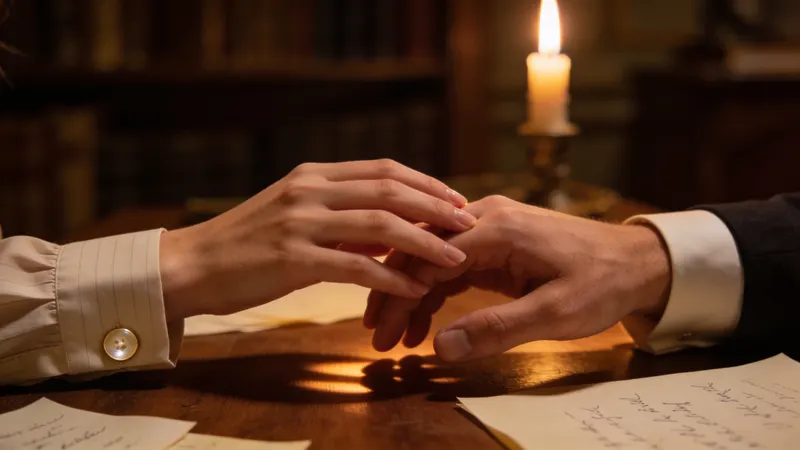
His fingers brushed hers, then curled gently around her palm. The touch was simple, but it unraveled something deep inside her, a release, a homecoming. She turned her hand, lacing her fingers with his.
They didn’t speak. They didn’t need to. The air between them was alive, humming with promise.
And when she stood to leave, he didn’t let go.
Clémence left Léon’s apartment with their hands still linked, the cool night air brushing against her skin, her heart full and unafraid. They walked slowly, not toward parting, but toward something unnamed and certain.
Both knew the next letter would no longer be anonymous.
Chapter 3: The Unveiling
The letter waited on her desk for three days, sealed with deep crimson wax imprinted with a single initial—hers. Clémence had written it in the quiet hours before dawn, when the city was still wrapped in mist and her skin still hummed from the memory of his touch. She hadn’t addressed it to anyone, hadn’t labeled it, but she knew exactly who would open it. The words had poured from her like a confession no longer meant for shadows: I dream of your hands. Not rough, not urgent, but certain—knowing where I’ve ached and where I’ve been untouched. I want to be seen by you, Léon. Not as a voice in a room, not as a nameless hand delivering words, but as a woman who has waited too long to say yes.
She described the shape of her desire, not conquest, not submission, but surrender to someone who looked at her as if he could read every silence between her breaths. I want you to touch me as if you’ve already memorized me. As if you’re not discovering, but remembering.
When she finally slipped it into the envelope slot of his building, hand-delivered, no return address, her hands didn’t tremble. She felt instead a kind of courage she hadn’t known since she was young, before the world taught her to fold herself small.
That evening, her phone lit up. A single message: Come to me tonight. If you’re ready.
She stood in front of her wardrobe for longer than she meant to, fingers skimming over silk and wool, before settling on a dress the color of midnight, simple, sleeveless, the kind that asked to be peeled away slowly. She didn’t wear perfume. She wanted him to know her as she was, warm skin, quiet pulse, the faint salt-sweetness of nerves and anticipation.
When she arrived, the door opened before she could knock. Léon stood there, barefoot, shirt unbuttoned at the collar, the faintest shadow of beard along his jaw. The apartment was bathed in soft light, lamps, not overheads, a single candle flickering on the coffee table. Music played low: Debussy, something fluid and aching. A bottle of Burgundy sat uncorked, two glasses waiting.
“You came,” he said, voice low, as if afraid to break the hush.
“I was ready,” she said.
He stepped aside to let her in, then closed the door gently behind her. No fanfare. No rush. Just the quiet acknowledgment that this was different. This was hers. His.
They sat on the couch, close but not touching, sipping wine. The conversation began carefully, about books, about the autumn light in Paris, about the way certain streets smelled after rain. But soon, the words turned heavier, deeper.
“I’ve lived alone for ten years,” he said, swirling the wine in his glass. “Not by choice, not exactly. After my wife died, I thought… I thought needing someone again would be a betrayal. That if I let myself want, I’d lose.”
Clémence set her glass down, turned to face him. “And now?”
“Now I think,” he said, meeting her eyes, “that not wanting is the real betrayal.”
She reached for his hand then, laced her fingers through his. “I wrote those letters because I was afraid to speak. But I’m not afraid now.”
He turned his palm upward, pressing her hand flat against his. His thumb brushed over her knuckles, slow, deliberate. “May I kiss you?”
“Yes,” she said, the word clear, certain.
He didn’t rush. He leaned in, one hand lifting to cradle the side of her face, his breath warm against her lips before they met. The kiss was soft at first, a question answered, then deepened as she leaned into him, her fingers curling into the fabric of his shirt. His mouth moved over hers with a reverence that made her chest ache, as if each touch were a promise.
When he pulled back, his eyes searched hers. “Is this okay?”
“It’s more than okay,” she whispered. “It’s everything.”
They moved slowly, hands learning the shape of each other. He unzipped her dress with careful fingers, letting it slip from her shoulders, pooling at her waist before she stepped out of it. She undid the buttons of his shirt one by one, tracing the warmth of his skin beneath. There was no urgency, only intention, each gesture a silent vow.
On the couch, wrapped in the glow of lamplight and music, she straddled him, bare, skin meeting bare skin. He looked up at her, wonder in his gaze. “You’re so beautiful,” he murmured. “Not just now. Always. Especially now.”
She leaned down, pressing her forehead to his. “Touch me,” she said. “Where I’ve wanted you.”
His hand slid between her thighs, slow, tentative. “Like this?”
She guided his fingers, just slightly, until they found the heat of her. “Yes,” she breathed. “I want that. I want you.”
He touched her with deliberate care, first a gentle stroke, then deeper, his rhythm matching the quiet rise of her breath. She rocked against his hand, eyes closed, lost in sensation, in the feeling of being known. When he slipped a finger inside her, she gasped, arching into him.
“Look at me,” he said.
She opened her eyes.
“Tell me if you want me to stop.”
“I don’t,” she said. “I want to feel everything.”
Later, when they were both bare and trembling, he entered her slowly, his gaze locked on hers. She wrapped her legs around his waist, drawing him deeper, and he let out a sound, half sigh, half prayer. They moved together, not for release but for connection, each thrust a silent affirmation, each pause a moment of recognition.
There were times when they simply held each other, foreheads touching, breath mingling, lost in the weight of what they’d found. And when she came, it was with his name on her lips and his hands holding her face, as if he were memorizing her.
Afterward, she lay against his chest, listening to the steady beat of his heart. The room was warm, the music still playing, the candle nearly spent. The sealed letter sat on the table, untouched. It didn’t need to be read aloud. It had already been lived.
The next morning, Clémence woke alone in his bed, sheets tangled around her legs, sunlight filtering through the blinds. She slipped on one of his shirts and padded barefoot into the study.
And there, open on his desk, was the salon’s newsletter.
Her name wasn’t listed. But the third letter, the one she’d written for him, the one meant only for his eyes, was scheduled to be read at the next gathering.
Her breath caught.
The hook of the moment settled deep: betrayal warred with understanding, fear with fury. But beneath it all, a single question burned.
Did he never intend to keep my secrets?
Chapter 4: The Final Confession
Clémence stood in the doorway of Léon’s study, the morning light painting golden stripes across the wooden floor. Her fingers curled around the edge of the doorframe, the cotton of his shirt soft against her bare legs. The newsletter lay open, innocuous in its simplicity, yet it felt like a breach. Her letter—her words, her longing, the most intimate confession, she’d ever written—was listed under the upcoming readings. Not as a submission. As an announcement.
She didn’t call out. Didn’t accuse. She simply stood there, absorbing the weight of it, the way her heart tightened like a fist. She thought of the night before, the way he’d touched her, the reverence in his voice when he whispered her name, the way he’d asked every time, as if her consent were the most sacred thing he’d ever held. And now this.
When Léon appeared behind her, barefoot and sleep-rumpled, his voice was soft. “Clémence.”
She turned slowly, the shirt slipping off one shoulder. “You’re going to read it. My letter. In front of everyone.”
He didn’t flinch. “I was going to tell you. I wanted to tell you. But I didn’t know how to say it without sounding like I was betraying you.”
“Then say it now,” she said, her voice steady despite the tremor beneath.
He stepped closer, hands at his sides, open. “I wasn’t going to read it without you. I never would. But Clémence… what you wrote, it’s beautiful. It deserves to be heard. Not as gossip, not as spectacle. As truth. As art. And as yours.”
She crossed her arms, the fabric brushing her collarbone. “You didn’t ask me.”
“No,” he admitted. “I didn’t. And that was wrong. I got carried away by how much it moved me. By how proud I was that you, that someone like you, wrote something so brave. I thought… I thought honoring it meant sharing it. But I see now. It’s not mine to share.”
She studied his face, the dark stubble along his jaw, the worry in his eyes, the way his throat moved when he swallowed. He wasn’t hiding. He was offering.
“You could have asked,” she said, softer now.
“I know. I should have. I was afraid you’d say no. Afraid you’d pull back. And I… I didn’t want to lose this. Lose you.”
She exhaled, the anger dissolving into something heavier, more complicated. “I’m not afraid of being seen anymore. But I want to choose how. I want to choose when.”
He nodded. “Then choose now.”
She looked at the newsletter again. Then at him. “Let me read it.”
His breath caught. “You’d do that?”
“I want to,” she said. “But on my terms. I’ll stand in front of them. I’ll say my name. I’ll own it. But I won’t be a secret passed around in the dark. I’ll be right there. Alive. Real.”
Léon’s eyes shimmered. “You’re extraordinary.”
She almost smiled. “Don’t make me a saint. I’m just a woman who finally learned how to speak.”
The night of the salon arrived, with a hush. The room was full, candlelit, expectant. Léon stood at the front, a single sheet in his hand. But when he looked up, he didn’t begin.
Instead, he said, “Tonight, we have something different.”
Clémence stepped from the back, her dress the color of midnight, her hair loose. She walked past the rows of chairs, past the murmurs, past the weight of a hundred curious glances. She didn’t falter.
Léon handed her the letter. Their fingers brushed.
She unfolded it, cleared her throat and began.
“I used to write to disappear,” she said, her voice clear, resonant. “To hide in words, to bleed onto paper so I wouldn’t have to speak. I wrote of surrender because I’d never been allowed to ask for it. I wrote of touch because I’d gone so long without it. I wrote of being seen, because I’d spent years pretending I wasn’t.”
She paused, her gaze finding Léon’s. “And then someone listened. Not just to the words, but to me. He didn’t take my story. He helped me find it.”
The room was silent. No one moved.
“I’m not ashamed anymore,” she continued. “Not of what I want. Not of what I needed. Not of the man who taught me that surrender isn’t loss. It’s return. It’s coming home.”
When she finished, there was stillness. Then, one by one, people began to clap. Quietly. Reverently. Not for scandal. For her.
Léon didn’t come to her right away. He waited, letting her have the moment. Then he rose, crossed the room, and took her hand.
They left together, fingers laced, heads high.
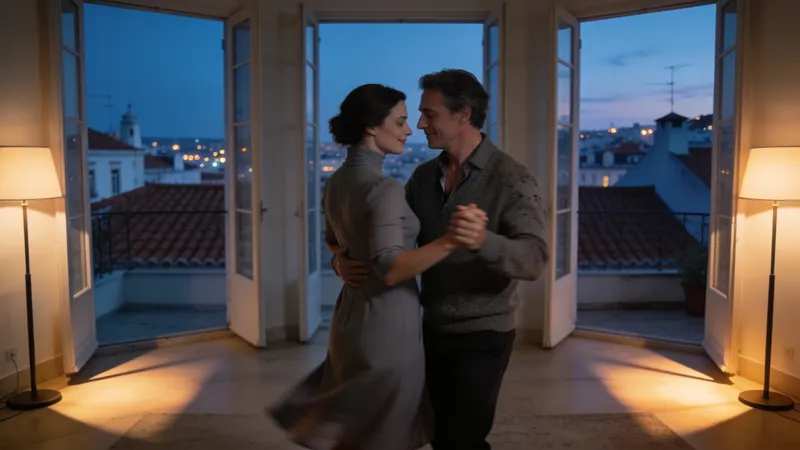
Back at her apartment, the city glowing beyond the windows, she sat at her desk and pulled out a fresh sheet of paper. The ink glided smoothly.
I used to write to disappear, she began. Now I write to be found.
She didn’t finish the letter. She didn’t need to. She set it aside, stood, and walked to where Léon stood by the window, looking out at Paris.
She stepped behind him, wrapped her arms around his waist, pressed her cheek to his back.
He turned in her embrace, cupped her face. “You were magnificent.”
She smiled. “I was honest.”
He kissed her, slow and deep, and when he pulled back, she whispered, “Now it’s your turn.”
He raised an eyebrow.
She slipped past him, climbed into bed, the sheets cool against her skin. She patted the space beside her.
“Come here,” she said. “Tell me your secrets now.”
The end
Editorial collection: The Half-Light Collection
Related stories